In
a previous post, I wrote about recent updates to the evidence from the cosmic microwave background for extra neutrino species. This was something that a lot of people in cosmology were prepared to get excited about, but I argued that reality turned out to be really rather boring. This is because the new data neither showed anything wrong with the current model of what the universe is made of, nor managed to rule out any competing models.
Today I'd like to write about something else, which currently
is a really exciting puzzle. Measurements have been made of a particular cosmological effect, known as the integrated Sachs-Wolfe or ISW effect, and the data show a measured value that is
five times larger than it should be if our understanding of gravitational physics, our model of the universe, and our analysis of the experimental method are correct. No one yet knows why this should be so. The point of this post is to try to explain what is going on, and to speculate on how we might hope to solve the puzzle. It has been written in a conversational format with the lay reader in mind, but there should be some useful information even for experts.
Before beginning, I should point out that this what a lot of my own research is about at the moment. In fact, this was the topic of a seminar I gave at the University of Helsinki last week (and much of this post is taken from the seminar). My host in Helsinki,
Shaun Hotchkiss, with whom I have written two papers on this "ISW mystery", has also put up several posts about it at
The Trenches of Discovery blog over the last year (see here for parts
I,
II,
III,
IV,
V, and
VI). I will be more concise and limit myself to just two!
Obviously you could view this as a bit of an effort at self-publicity. But at a time when, both in particle physics and cosmology, many experiments are disappointingly failing to provide much guidance on new directions for theorists to follow, this is one of the few results that could do so. (Unlike a lot of the
rubbish you might read in other popular science reports, it also has a pretty good chance of being true.) So I won't apologise for it!
What is the integrated Sachs-Wolfe effect?
The entire universe is filled with very cold photons. These photons weren't always very cold; on the contrary, they are leftovers from the time soon after the Big Bang when the universe was still very young and very small and very hot, so hot that all the protons and electrons (and a few helium nuclei) formed a single hot plasma, the photons and electrons bouncing off each so often that they all had the same temperature. And as the universe was expanding, this plasma was also cooling, until suddenly it was cool enough for the electrons and protons to come together to form hydrogen atoms, without immediately getting swept apart again. And when this happened, the photons stopped bouncing off the electrons, and instead just continued travelling straight through space minding their own business, cooling as the universe continued to expand. (The neutrinos, which only interact weakly with other stuff, had stopped bouncing and started minding their own business some time before this.)
What I've just told you is a cartoon picture of the history of the early universe. These cooling photons streaming through space form the cosmic microwave background radiation, or CMB for short. They fill the universe, and they arrive at Earth from all directions – they even make up about 1% of the 'snow' you see on an (old-school) untuned TV set.
The most important property of the CMB photons is that, to a very great degree of accuracy, they are all at the same temperature, whichever direction they come from. This is how we know that the universe used to be very hot, and how we learned that it has been expanding since then. It is also why we think it is probably very uniform. The second important property of CMB photons is that they are
not all at the same temperature – by looking carefully enough with an
extremely sensitive instrument, we can see
tiny anisotropies in temperature across the sky. These differences in temperature are the signs of the very small inhomogeneities in the early matter-radiation plasma which are responsible for all the structure we see around us in the night sky today. When the photons decoupled from the primordial plasma, they kept the traces of the tiny inhomogeneities as they streamed across the universe. The matter, on the other hand, was subject to gravity, which took the small initial lumpiness and over billions of years caused it to become bigger and lumpier, forming stars, galaxies, clusters of galaxies and vast clusters of clusters.
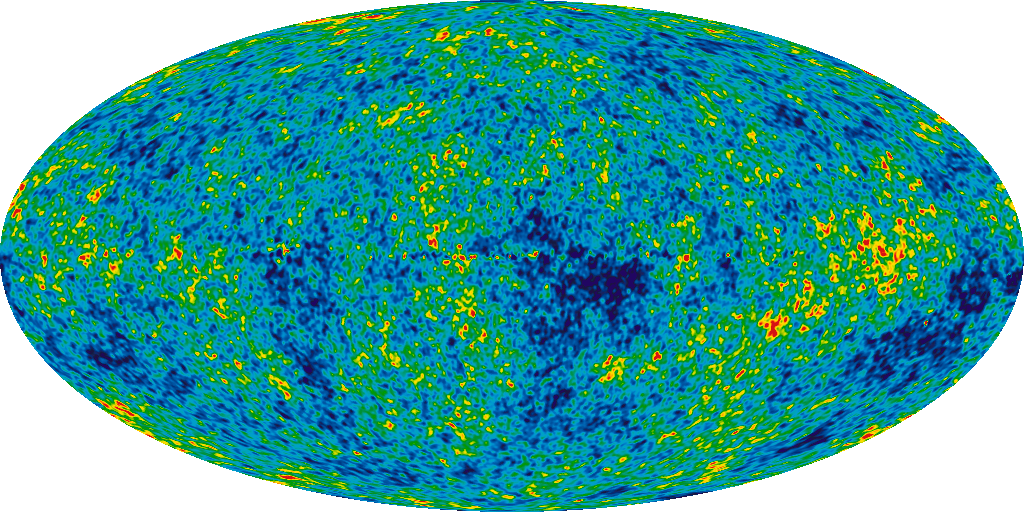 |
| The CMB sky as seen by the WMAP satellite. The colours represent deviations of the measured CMB temperature from the mean value – the CMB anisotropies (red is hot and blue is cold). This map uses the Mollweide projection to display a sphere in two dimensions. Image credit: NASA / WMAP Science team. |
Yes I knew that, but what is the integrated Sachs-Wolfe effect?
 That's pretty cool. Also nice to see the gif format being put to better use than endless animations of cats doing silly things! (Though if you are a PhD student, you might find this use of gifs amusing ... )


