Showing posts with label economics and politics. Show all posts

Tuesday, February 19, 2013

Things to Read, 19th February

I have just arrived in Helsinki, where I am visiting current collaborators and future colleagues at the Helsinki Institute of Physics for a few days. I will give a talk next Wednesday, about which more later. In the meantime though, a quick selection of interesting things I have read recently:
  • Did you know that about 6 million years ago, the Mediterranean sea is believed to have basically evaporated, leaving a dry seabed? This is called the Messinian Salinity Crisis, which I first learned about from this blog. There's also an animated video showing a hypothesised course of events leading to the drying up:


    Very soon after, the Atlantic probably came flooding back in over the straits of Gibraltar – an event known as the Zanclean Flood – and, according to some models, could have refilled the whole basin back up in a very short time. Spare a thought for the poor hippopotamuses that got stuck on the seabed ...
  • A long feature in next month's issue of National Geographic Magazine is called The Drones Come Home, by John Horgan. Horgan has written a blog piece about this at Scientific American, which he has titled 'Why Drones Should Make You Afraid'. In the blog piece he has a bullet-point summary of the most disturbing facts about unmanned aircraft (military or otherwise) taken from the main piece. Some of these include:

    - "The Air Force has produced [a video showing] possible applications of Micro Air Vehicles [...] swarming out of the belly of a plane and descending on a city, where [they] stalk and kill a suspect."
    - "The Obama regime has quietly compiled legal arguments for assassinations of American citizens without a trial"
    - "The enthusiasm of the U.S. for drones has triggered an international arms race. More than 50 other nations now possess drones, as well as non-governmental militant groups such as Hezbollah."

    Scary stuff; worth reading the whole thing.
  • I wrote some time ago about Niall Ferguson's argument about economics with Paul Krugman (this was in the context of a lot of nonsense Ferguson was coming up with at the time, both in his Reith lectures for the BBC, and in other publications). I just learned (via a post by Krugman, who also just learned) that Ferguson had already apparently admitted that he got it wrong, about a year ago. Krugman's response to that is here; I'd add that I notice this admission didn't seem to stop Ferguson continuing the same economic reasoning in his Reith lectures a few months later!
  • A review of John Lanchester's new novel Capital, by Michael Lewis in the New York Review of Books. Quite often Almost always with the NYRB, I read reviews of books before I have read the actual book. In this case the result was to make me resolve to buy a copy.

Sunday, December 2, 2012

Things to Read, 2nd December

Time for another collection of worthwhile links from elsewhere on the internet.

Science links:
  • Jester at Résonaances has been producing a series of very good informative posts from the frontlines of particle physics: particularly worth reading are this summary of the state of play with the "detection" of dark matter by the Fermi telescope, this explanation on what is and isn't contained in the new Higgs analyses from the LHC, including intriguing information on why some data hasn't yet been updated, and this take on the relevance of the LHCb measurements of Bs meson decay for supersymmetry (which has been the subject of a lot of hype in the popular press).
  • Speaking of the popular press, Time magazine has seen fit to nominate the Higgs boson as one of the candidates for "person of the year" (you can vote for it if you like). As if that weren't ridiculous enough, the accompanying description must surely qualify as one of the worst pieces of science journalism ever: literally every single sentence is wrong. Worth a look — even if you're not a physicist, you might be able to spot the mistakes.
  • I've recently discovered a series of super-slow-motion videos of lightning strikes knocking around on the internet. These are shot at several thousand frames per second, and really show the details of how the charge leaders meander towards the ground before the main secondary stroke follows. Even more interesting are some videos showing lightning travelling upwards, from ground to cloud. Here's a video:

    and here's a popular-level description of the phenomenon.
  • Another particularly cool video I saw some time ago was this one, showing the synchronisation of 32 metronomes placed on a flexible platform:


Other links:
  • This one is part science, part history and part politics. Have you ever wondered what the connection is between prehistoric plankton from the Cretaceous era, and the distribution of votes for Obama? Of course you haven't, but now you can find out anyway. 
  • On a more serious note: one of the striking things about the US election was how completely wrong Republicans and the right-wing were in their predictions of the outcome. Especially so since there were so many people who were able, by simple analysis of the available facts, to arrive at predictions that were much better (Nate Silver, for one). There is lots to be said about this, I suppose. One striking observation, which maybe hasn't been made enough of, is the hope that people realise that if the right-wing media can spout such rubbish (not to say lies) about the polls, perhaps the rest of what they say is rubbish too
  • And following on from that, an interesting article from someone on the right of American politics: The Revenge of the Reality-Based Community.
  • It's not just in the US that facts have a well-known anti-right-wing bias of course. And it's not just US right-wing politicians who dislike them. When economist Jonathan Portes of the National Institute for Economic and Social Research appeared before the UK parliament and explained some fairly elementary economics that happens to contradict the ideology of the Conservative Party, he received thinly veiled threats from MP Jesse Norman (watch; transcript). This drives other economists to express their equally thinly veiled contempt. Norman responds, and Wren-Lewis dismisses him again.
  • And finally, something more cheery: some time ago I posted the story about the dog who climbed a mountain with me in the Himalayas. I thought that dog was pretty awesome, but then I saw this dog, who seems to have done an even harder climb!

    (She does seem to have a protective harness though, which probably gives her an unfair advantage ...)

Saturday, November 10, 2012

Does Nate Silver get his maths wrong?

Although I haven't had much time to write anything new for this blog recently, like most people I know I have of course been paying close attention to the unfolding circus of the US Presidential election. Now that all the action is done and dusted, there is a lot of discussion on the internet about the predictions made by poll aggregators, the best-known of whom is the New York Times blogger and statistician Nate Silver. And although I'm not going to talk about politics, I do want to make a comment about probabilities and the statistics of poll aggregation.

The reason Silver has been in the news so much is because even when a lot of innumerate and possibly partisan journalists were making a huge amount of noise about "Romneymentum" and predicting a landslide Republican victory, Silver calmly analysed the actual polls and stated that the odds continued to favour an Obama victory. For this he attracted an enormous amount of flak in the right-wing press and blogs, and a substantial section of the mainstream media refused to believe him. (See here if you'd like a frequently-updated list of everyone who attacked Silver and ended up looking stupid.) Even on election eve, when Silver gave Obama more than a 90% chance of victory, such impartial websites as the BBC continued to describe the result as being on a "knife-edge".

Of course now that Obama has won, the pendulum has turned the other way, and Silver is being hailed as a mathematical genius, a wizard, a guru and much else besides. This adulation rather ignores the fact that there were several other bloggers and poll aggregators who also predicted an Obama win. Some of these are Sam Wang at the Princeton Election Consortium, Drew Linzer at Votamatic, Pollster at the Huffington Post, Simon Jackman and so on. (To be fair, Silver does have a much more prominent position than the others, being at the New York Times. He did also provide very insightful regular explanations and updates, and some nice interactive graphics to help explore the data, so one can forgive the extra attention given to him.)

But the interesting question is not whether Nate Silver does a better job of predicting elections than, say, Donald Trump. How does he compare with other, equally numerate and mathematically minded poll-aggregating bloggers? And there is really a difference between them: for a large part of October, Silver rated Obama's chances of re-election at only around 65-75%, whereas Sam Wang regularly claimed it was more like a 99% chance. Or have a look at Votamatic, where the predicted median of electoral college votes for Obama has been fairly constant at 332 (the correct number) since July, compared to Silver's prediction of closer to 290 at the same time. You'll also notice, if you play with the graphics at FiveThirtyEight, that the margin of error Silver quoted on his prediction was significantly larger than that the other forecasters gave.

So in summary, Nate Silver made more conservative predictions and was more pessimistic about Obama's re-election chances than his direct competitors. (Why so? As I understand it, Wang and Linzer only include information from published poll data, appropriately weighted for freshness and sample size. Silver included also what he calls "fundamentals" — his estimate of other underlying factors, such as economic data and so on, which might influence the final outcome. Silver's exact model is proprietary, but for an educated guess at how it works, explained in layman's terms, see here.) In the end though, Obama was re-elected, as all the forecasters said he would be. Since the only differences between them lay in exactly how confident they were in their prediction (and also whether they thought he would win Florida ... ), and the election can only be run once, how do you decide whose model is better?

A common argument you may have heard in favour of Silver before Obama's most recent victory is that he correctly predicted 49 out of 50 state results in 2008. Add to that his predictions this year and his tally is now 99 correct out of 100. This is obviously impressive, and clearly you should trust Silver and his maths more than basically every conservative hack who attacked him.

But the problem is that Silver may be too accurate. To put it bluntly, if you say the probability of your prediction being correct is around 70%, you should expect to be wrong 30% of the time, not 1% of the time. So if you predict the right result 99% of the time but quote probabilities of only 70%, you are probably overstating the error bars on your prediction. On the other hand, if someone else says he is 99% sure and is right 99% of the time, his model might be better.

OK, some obvious caveats. It is misleading to count all 50 state predictions as successes for Silver's model. I doubt even Donald Trump would have had trouble predicting Utah would go Republican and New York would go Democrat. In reality, there were only around 10 or 11 states that were at all competitive in each election cycle, so adjusting for that would mean lowering Silver's actual success percentage. Also, his model didn't predict all results with equal confidence — for instance, maybe he gave only a 75% probability for Obama to win Ohio, but a 99% probability for him to win Minnesota.

How should one account for this in quantitatively comparing models? Unsurprisingly, Sam Wang himself suggests a method, which is to assign each prediction a Brier score. This takes the square of the difference between the predicted probability of an event occurring — e.g., 0.75 for a prediction of 75% probability — and the post facto probability (i.e. 1 if it did happen, 0 if it didn't). In the case of multiple predictions (for multiple states), you then average the Brier score for each prediction. Thus the Brier score punishes you for getting a prediction wrong, but it also punishes you for hedging your bets too much, even if you got the end result right. Getting a Brier score of exactly 0 would mean you knew the results in advance, getting a score of 0.25 is equivalent to just guessing randomly (if there are only two possible outcomes).

Have a look at Wang's result tables: it looks as though he did slightly better than Silver in predicting the Presidential race, and much better in predicting the Senate results. As he rather pithily put it,
additional factors used by FiveThirtyEight – “fundamentals” – may have actively hurt the prediction. This suggests that fundamentals are helpful mainly when polls are not available.
Anyway, the point of this post, despite the deliberately provocative title, was not really to attack Nate Silver. Even if he did hedge his bets and overstate his error bars a little, given his very public platform and the consequent stakes, I think that's understandable. The Princeton Election Consortium and Votamatic really don't have the same exposure, so Wang and Linzer would have faced less general opprobrium if they had made a mistake. Also, perhaps more statistics are needed to really make a judgement — though let's not have another election for some time please!

But I think this does illustrate a subtle point about probabilistic predictions that most of the media seem to have missed, so it is worth pointing out. And I feel a little personal guilt for being too pessimistic to believe Sam Wang before last Wednesday!

Tuesday, October 16, 2012

Ignoring the evidence: politics as usual

I have not had time to write a new post of my own for some time because real life has intervened, partly in the form of my day job (a project I am working on is nearing completion, and I am also preparing several seminar talks and grading a student's thesis), and partly in the form of other inconvenient distractions (writing job applications for next year, trying to find a new apartment and so on).

I hope to find some time to rectify this in the near future, but in the meantime I thought I would reblog a post by Simon Wren-Lewis, titled When policy ignores evidence: badgers and austerity. As you can guess from the title, it deals with just two examples demonstrating the apparent incompatibility of evidence-based rationality and politics. In fact, these examples seem to show politicians not so much failing to account for the scientific evidence as deliberately ignoring it.

This is a theme I wrote a bit about here. If that piece sounded rather cynical, well, things like this are the reason why.
 When policy ignores evidence: badgers and austerity: [...] Badgers get, and spread, TB. As a result, the UK government is about to begin a large scale cull of badgers in Gloucestershire and Somerset. No one likes the idea of killing badgers. But cattle (or occasionally alpacas) dying from TB is no fun either. So the badger cull is just one of those necessary bad things that have to be done to prevent something even worse happening. Environmentalists are up in arms, but that is just because badgers look cute and cattle do not.

Except that is not what the evidence suggests. Following various small scale randomised badger culling trials, the UK government set up an independent group of scientists (the ISG) to evaluate the evidence. In 2007 the government published the report (pdf). It concluded as follows:
“The ISG’s work – most of which has already been published in peer-reviewed scientific journals – has reached two key conclusions. First, while badgers are clearly a source of cattle TB, careful evaluation of our own and others’ data indicates that badger culling can make no meaningful contribution to cattle TB control in Britain. Indeed, some policies under consideration are likely to make matters worse rather than better. Second, weaknesses in cattle testing regimes mean that cattle themselves contribute significantly to the persistence and spread of disease in all areas where TB occurs, and in some parts of Britain are likely to be the main source of infection. Scientific findings indicate that the rising incidence of disease can be reversed, and geographical spread contained, by the rigid application of cattle-based control measures alone.”
On Sunday 30 eminent UK and US scientists published a letter in the Observer. They write: “As scientists with expertise in managing wildlife and wildlife diseases, we believe the complexities of TB transmission mean that licensed culling risks increasing cattle TB rather than reducing it.” One of the signatories described the government’s policy as crazy, and suggested vaccination and biosecurity was a better solution. The Guardian reports the chair of the ISG as saying “I just don't know anyone who is really informed who thinks this is a good idea." The current government chief scientist said: "I continue to engage with Defra [the relevant government ministry] on the evidence base concerning the development of bovine TB policy. I am content that the evidence base, including uncertainties and evidence gaps, has been communicated effectively to ministers." In other words, ministers know what scientists are saying and have decided to ignore them.

So what is going on? One of the strongest pressure groups in the UK is the National Farmers Union (NFU) [...] The NFU are convinced that culling badgers will reduce the incidence of TB in cattle, and government policy is following that belief, rather than the scientific advice it commissioned. (For more details, see George Monbiot here.) The BBC reports Defra Minister David Heath as saying "No-one wants to kill badgers but the science is clear that we will not get on top of this disease without tackling it in both wildlife and cattle." Dare I say weasel words.

[...] With austerity we did not have randomised trials: we had one almost globalised trial, starting in 2010, and one eighty years earlier. The evidence this time round is becoming clear: the harmful effects are much greater than many had assumed.

[...] perhaps the two cases are not so different. The problem with austerity is that too many people of influence just know that high government debt is always and everywhere a bad thing. Too many think it is just obvious that when a country has difficulties in selling debt that must imply cutting it back as quickly as possible, in the same way that it is obvious that killing badgers must reduce the spread of TB. And perhaps too many people see badger culls as part of a battle between farmers and environmentalists, just as austerity is a weapon in a battle over the size of the state.

Maybe we are just naive in thinking that as the evidence against austerity accumulates, and as those that were once for it change their mind, the policy will change. As Wolfgang Munchau writes (FT): “As hordes of frustrated European economists know only too well, macroeconomic analysis in general does not play a role in eurozone policy making.” So the policy goes on, in both the UK and the Eurozone, and I do not like to think about what might happen in the US if Romney wins. While I would never advocate a totally uncritical acceptance of the views of scientists, we are an awfully long way from that position, as unfortunately many badgers are about to find out.

Saturday, September 15, 2012

Calling on Germany

In the New York Review of Books, George Soros has written an excellent long piece on the future of the European Union in light of the Eurozone economic crisis. If what happens in the EU in any way affects your life (and it almost certainly does), you should read it. There is a lot to ponder over in there, including a brief history of European cooperation, an astute diagnosis of the economic problems, and a bold call for action that is unlike anything that has been said anywhere else. It is also written from the perspective of a heartfelt supporter of the idea of a united Europe.

It is that call for action that gathered the most attention in the press, making several newspaper headlines. Soros is quite blunt: he says straight out that at every stage in the crisis, Germany's intention has been to do the absolute minimum required to avert disaster — with the end result that no resolution has been reached, and the can is just a few metres further down the road.
The policies pursued under German leadership will likely hold the euro together for an indefinite period, but not forever. [...] If and when the euro eventually breaks up it will destroy the common market and the European Union. Europe will be worse off than it was when the effort to unite it began, because the breakup will leave a legacy of mutual mistrust and hostility. The later it happens, the worse the ultimate outcome. That is such a dismal prospect that it is time to consider alternatives that would have been inconceivable until recently.

In my judgment the best course of action is to persuade Germany to choose between becoming a more benevolent hegemon, or leading nation, or leaving the euro. In other words, Germany must lead or leave.
Strong words indeed, and not an angle I have seen advocated (explicitly) by anyone else yet. He then goes on to explain a bit more.
Since all the accumulated debt is denominated in euros it makes all the difference who remains in charge of the euro. If Germany left, the euro would depreciate. The debt burden would remain the same in nominal terms but diminish in real terms. The debtor countries would regain their competitiveness because their exports would become cheaper and their imports more expensive. The value of their real estate would also appreciate in nominal terms, i.e., it would be worth more in depreciated euros.

The creditor countries, by contrast, would incur losses on their investments in the euro area and also on their accumulated claims within the euro clearing system. The extent of these losses would depend on the extent of the depreciation; therefore creditor countries would have an interest in keeping the depreciation within bounds.

The eventual outcome would fulfill John Maynard Keynes’s dream of an international currency system in which both creditors and debtors share responsibility for maintaining stability. And Europe would escape from the looming depression. The same result would be achieved, with less cost to Germany, if Germany chose to behave as a benevolent hegemon. That would mean (1) establishing a more or less level playing field between debtor and creditor countries and (2) aiming at nominal growth of up to 5 percent, in other words allowing Europe to grow its way out of excessive indebtedness. This would entail a greater degree of inflation than the Bundesbank is likely to approve.

Whether Germany decides to lead or leave, either alternative would be better than to persist on the current course. The difficulty is in convincing Germany that its current policies are leading to a prolonged depression, political and social conflicts, and an eventual breakup not only of the euro but also of the European Union. How to persuade Germany to choose between either accepting the responsibilities and liabilities that a benevolent hegemon should be willing to incur or leaving the euro in the hands of debtor countries that would be much better off on their own? That is the question I shall try to answer.
As I said, go and read the full argument.

One thing that is generally accepted by everyone is that the ultimate resolution of the Eurozone crisis can only come about through a relative decrease in the wages and prices in debtor countries (Spain, Italy, Portugal et al.) compared to Germany, in order to restore their competitiveness. This can happen in one of two ways: slightly higher inflation in Germany than in other countries, or deflation in other countries and stable prices in Germany. Most people also agree that achieving this entirely through deflation in debtor countries is not only highly unlikely to work, but also exacts a terrible and unnecessary human cost.

This is why Soros argues for Germany to make the sacrifice and accept moderate inflation. He accepts that this is a very hard pill for the Germans to swallow:
[T]he Bundesbank remains committed to an outmoded monetary doctrine that is deeply rooted in German history. Following World War I, Germany had a traumatic experience with inflation; consequently it recognizes only inflation as a threat to stability and ignores deflation, which is the real threat today.
The genuineness of this fear of any inflation is not in doubt. Nevertheless, if you think about it, it is a little bit strange. It is often argued that the Weimar inflation was one of the driving factors behind the rise of the Nazis, and that this contributes to the national psychological scarring. But surely this is the wrong historical lesson. As a few people have argued before, the period of the most dramatic growth in the Nazi share of the vote — from 2.6% in 1928 to 37.8% in 1932 — was long after the awful inflation, and coincided almost exactly with the Great Depression, during which the deflationary policies of Chancellor Brüning dramatically increased unemployment and lowered national income. If we must bring the Nazis into it, we should at least draw the right conclusions.

Thankfully, since Soros wrote his piece, events have moved quickly in Europe and it looks as though a combination of the ECB, the German courts, Spanish firmness and Angela Merkel's surprising new attitude have gained the upper hand over the president of the Bundesbank. Which is just as well, because as Kevin O'Rourke pointed out two years ago, looking at the massive unemployment, civic unrest and success of extremist parties in Europe today would not otherwise leave much room for optimism.

Saturday, September 8, 2012

Things to Read, 8th September

I have been neglecting this series over the summer, so there are rather a lot of things to highlight today.

Science items:
  • The most interesting piece of physics news over the last few months has been that the wealthy Russian investor and physics fan, Yuri Milner, decided to award a 'Fundamental Physics Prize' to 9 theorists he chose himself. The amount of the award is a staggering $3 million each, wired overnight into the physicist's bank accounts — as many people have pointed out, this makes the prize worth far far more than the Nobel Prize. Suddenly being a physicist almost appears to be a lucrative career choice. The lucky physicists were Nima Arkani-Hamed, Alan Guth, Alexei Kitaev, Maxim Kontsevich, Andrei Linde, Juan Maldacena, Nathan Seiberg, Ashoke Sen and Ed Witten. All big names in theoretical physics.
  • Unsurprisingly, the award of this prize generated a lot of debate. For one thing, it is a huge amount of money. For another, the prizes were awarded basically on the whim of one man, who is not a physicist himself. But perhaps the most controversial thing was reported in the New York Times:
    Unlike the Nobel in physics, the Fundamental Physics Prize can be awarded to scientists whose ideas have not yet been verified by experiments, which often occurs decades later.
    This was picked up on by Peter Woit, who is of course well-known for his dislike of some of the work on string theory that the said physicists are famous for, and was highly critical of the prize, including in an article for an Italian newspaper (English transcript from his blog). I guess most physicists would share his unease with the prize, if perhaps not with string theory itself. It was quite amusing to read Matt Strassler finding himself in a position of agreement with Woit but managing to attack him nevertheless (I get the feeling he really dislikes Woit).
  • Motivated by this discussion, Strassler did put up a very interesting and nuanced personal defence of string theory. Whether you have an opinion on 'The String Wars' or not, you will probably have heard strong criticisms of string theory. This piece will provide some balance.
  • Among the other worthwhile physics discussions were two guest posts at Cosmic Variance: by Terry Rudolph and Douglas Finkbeiner. Both discuss recent research work (in quantum mechanics and searches for dark matter, respectively) and both include interesting little insights into the world of academic publishing.
  • Outside physics, I saw a piece by Dr. Dave Hone in the Guardian science section that includes the lines:
    [...] we have dinosaurs everywhere around us. We have dinosaurs nesting in trees in our gardens, tiny dinosaurs that can hover and fly backwards and feed on nectar, aquatic dinosaurs that live in Antarctica. There are dinosaurs that we eat, we have dinosaurs that can circle the globe without landing, intelligent and puzzle-solving dinosaurs, tall and flightless dinosaurs that can sprint at over 40 miles and hour, and brightly coloured and beautiful dinosaurs almost too numerous to mention.
Other items:
  • Of course the big news over the summer has been the Olympics. It's been impossible to miss the outpourings of national pride in British newspapers at Team GB's medal tally and I have heard also of despondency in countries such as Russia and Australia. But what is the benefit to a nation from this arms race for medals? This was discussed, rather provocatively perhaps given the timing, by Ian Johnson in the New York Review of Books
  • There's been a lot of discussion in the US about the Republican presidential ticket, and in the UK about the dire state of the national economy, now in a longer slump than during the Great Depression. Paul Krugman made the obvious connection, and labelled Chancellor of the Exchequer George Osborne "Britain's Paul Ryan." That post includes a graph that should be shown to everyone who still believes austerity in the recession is the answer to anything:

    One could forgive Krugman for feeling rather frustrated (and perhaps a little smug), because this is pretty much exactly what he predicted back in 2010:
    The British government’s plan is bold, say the pundits — and so it is. But it boldly goes in exactly the wrong direction.
    See also here.
  • Of course some people might remember the 20 "leading economists" who wrote an open letter to The Sunday Times supporting George Osborne's fiscal plans back before the 2010 election. Well, some time ago the New Statesman had the bright idea to go back and ask them if they still stuck by their advice: 9 of the 20 had changed their minds, 10 refused to comment, and only one still agreed with himself.
  • You might wonder what a poor politician is to do: if you have only a degree in History and an ideology as substitutes for genuine competence, you naturally rely on the advice of professional macroeconomists. But when the economists disagree with each other, which ones should you listen to? Jonathan Portes had a post laying out some sensible criteria for judging who to take seriously. Unsurprisingly, people like Krugman, Simon Wren-Lewis and Martin Wolf passed the test, but none of the Sunday Times economists did. Portes notes that not all those who pass his test always agree with each other — but he still always takes them seriously.
  • The New York Review of Books carries a review of two books on the current global and American economic mess by Paul Krugman (End This Depression Now!) and Joseph Stiglitz (The Price of Inequality: How Today's Divided Society Endangers Our Future). What particularly interested me here was learning just how radical Stiglitz appears to be.
  • Incidentally, for those who were interested in the Niall Ferguson episode featured here, John Cassidy in the New Yorker has a longer look at the arguments, and comes to the same conclusions: Ferguson is a lightweight who is being repeatedly knocked to the canvas, and this "isn't a fair fight".
  • And finally, since I'd like to end on an uplifting note, here's a video to cheer us all up.

Wednesday, August 22, 2012

The disgrace of Niall Ferguson

(The content of this post is somewhat beyond the usual remit of this blog.)

A month or so ago, a friend drew my attention to the 2012 BBC Reith Lectures given by Niall Ferguson, a Harvard professor of economic history. This is a particularly prestigious lecture series on BBC Radio 4. Past lecturers have included many famous names, from Bertrand Russell in 1948 to Aung San Suu Kyi in 2011; I would recommend several previous lectures. But on listening to Ferguson, I was so annoyed by the combination of factual errors, non sequiturs, deliberate misrepresentations and schoolboyish debating tactics I heard that I almost composed a long diatribe for this blog to point them all out. In the end I refrained, partly for the sake of my blood pressure.

Now, however, Ferguson is back in the news, for an execrable cover story in Newsweek attacking Barack Obama's economic policy that contains many of the same tactics he employed in his Reith lectures, and I can no longer pass up the opportunity to comment. Luckily the Newsweek story has stirred up such justifiable disdain everywhere that I will be able to outsource much of the detailed commentary and merely provide you with a round-up of the reasons why you should never believe a word Ferguson says or writes.

Saturday, August 4, 2012

Why don't more scientists enter politics?

This is a question posed by Shaun over at The Trenches of Discovery, in a piece I would urge you to read. He argues that scientists are not shy of expressing opinions on matters of political interest, and scientists are well-qualified (some would say better qualified than most) to offer opinions on, and to frame, policies on matters of great importance to society. So why are they under-represented in politics?

I found this a bit of a thought-provoking question. As readers will have noticed, this particular science blog is not backward in expressing political opinions, so some sort of considered response appears to be in order. If you click through to Shaun's post you can see some of my immediate reactions in the comments; however, while I am happy to shoot from the hip over at his blog, I will try to express myself more coherently and thoughtfully on my own.

Wednesday, July 25, 2012

Be very, very afraid

Paul Krugman cannot believe the lack of terror among German politicians about the spectre of a Greek exit from the Euro. Do they really think that if Greece is forced out, Spain will not be forced to follow?

In fact the disturbing news from Germany has got most economists spooked — or at least most economists who aren't willfully blinkered. Some time ago, I noted here that Simon Wren-Lewis was holding out some hope for the survival of of the Euro, because he felt sure Eurozone officials would eventually see that hard-line moral posturing was detrimental to their own interests (apart from being wrong). Sadly, it appears not even he is so optimistic any more:
Sometimes it seems as if Germany and its supporters are like a poker player with a very weak hand, who has managed to convince all the other players that their hand is much stronger than it is. But there is a danger that you may get so good at playing this bluff, that you may stop looking at your cards and actually believe you have a strong hand. Or worse still, that although your hand is weak, you deserve to have the better cards, and therefore you do have the better cards.
The situation with German public opinion is now so dire that although he is careful not to explicitly say so, I think Wren-Lewis now agrees with Greek economist Yanis Varoufkis' assessment that Germany actually doesn't want to solve the Eurozone crisis.

Which brings us back to Krugman's take on the foolish lack of terror.

Tim Duy agrees, asking whether a panic button even exists in Europe:
I doubt we will need to wait much longer to learn the outcome of Grexit. But the devastating train that is the debt crisis keeps rolling right along, currently crashing through Spain's economy.

And make no mistake, European policymakers have learned nothing from the Greek experience. One gets the sense that policymakers think the prescription was correct, but that the patient was simply unwilling to take the medicine. Where Greece failed, Spain will succeed, or at least so it is hoped [...] Spain is doing the right thing, apparently. It's just the markets that have it all wrong [...] And in return for this bailout, Spain will be pushed further down the same path of never ending recession as Greece. Because if once you don't succeed, try, try again. European policymakers will pursue the same path because they know of no other [...]

In my view, the lack of panic is downright scary. Is Europe completely devoid of new ideas? Or is everyone simply on vacation?
Surely, you feel, we will wake up soon and learn this was all a dream? Surely somebody will remember which country's banks it was that lent the money to Greece, Spain, Ireland, Italy, Portugal et al. in the first place, and which country's banks therefore stand to lose most if they collapse? Surely someone will remember who was "the sick man of Europe" before the introduction of the Euro helped turn their economy around?

But no. The words 'face', 'spite', 'chop' and 'nose' come to mind.

Monday, July 16, 2012

Things To Read, 16th July

When I first decided to start collecting together links to interesting things on the internet and putting them into one blog post per week, I was envisaging something like a less frequent version of this. Instead these posts have become something slightly different: longer, because I like to add short comments on the articles I link to; and perhaps more selective. This meant that these posts were becoming a little too much work! I also don't always find enough physics links to highlight each week.

So I have decided to embrace the change: these posts will remain a regular feature, but no longer necessarily a weekly feature. Instead I shall put them out as and when I have collected enough items I'd like to point out and briefly comment on. The title of the series will also be amended to reflect this.

Anyway, since I have already started writing something for today, I will include a few items:
  1. I was particularly interested in this little post by Julianne Dalcanton at Cosmic Variance, about the employment chances for physicists who choose to, or for whatever reason have to, leave the world of academia. The statistics — at least in the US — appear to be relatively encouraging, and somewhat better than for "lab-based" biologists or chemists. Julianne has her speculations as to why this should be so; I suppose they sound quite plausible.
    I think the other point she makes is really important too — students enrolling for physics PhD programmes really ought to be aware that the odds against them ever getting a permanent academic position equivalent to that of their advisor are very small. Say the average professor sees one student through to a PhD every two years. Over a career of 40 years, that's 20 completed PhDs, and yet when that professor retires, only one permanent faculty position becomes available. Odds like that mean that, unlike the UK government, every sensible PhD student should be aware of the need to have a Plan B. This applies also to those of us who have been lucky enough to get a foot on the ladder in the form of a post-doc job (though I don't seem to have taken my own advice yet!).
  2. Tucked away in the Guardian, I saw this report on the treatment in Pakistan of Nobel-Prize-winning particle theorist Abdus Salam, both before and after his death in 1996.
  3. Anyone who has been following the US Presidential elections will know that there has been some amount of kerfuffle recently about who was in charge of which company when. You could see this for a little perspective, or doubtless there are countless other places you could read about it. Anyway, that's not what interests me: I don't have a vote in this election, and if I did, I wouldn't need stories about Bain Capital to know that Romney is a ridiculous candidate.
    Instead, I think the significant occurrence from the last week was this quote from Barack Obama:
    [I]f you’re a head of a large private equity firm or hedge fund, your job is to make money. It’s not to create jobs. It’s not even to create a successful business – it’s to make sure that you’re maximizing returns for your investor. Now that’s appropriate. That’s part of the American way. That’s part of the system. But that doesn’t necessarily make you qualified to think about the economy as a whole ...
    Phew. At last some politician has come out and said something sensible. I would have thought it was fairly obvious that the analogy between running a country and running a business was completely wrong — after all, I doubt there is a company anywhere in the world that sells its product primarily to its own employees — but still most politicians continue to treat people like idiots. This is not restricted to the US: in Britain the analogy used by the Tories is different — that government budgets are like family budgets, complete with credit cards and tightening belts — but the underlying fallacy is basically the same (which family buys goods and services primarily from itself?). I don't know exactly what rhetorical devices politicians use in Germany, Spain, Greece and the like, but from the utter mess they have made of the Euro, one can surmise that they must be equally stupid. So one-and-a-half cheers for Obama for attempting to right that trend.

Monday, July 2, 2012

LftW: 2nd July

Physics links:
  • The important physics event of the next week will be the CERN press conference on the Higgs search analyses coming up on Wednesday at 9 am CEST. Peter Woit provides a preview, summarising what we might expect to hear. At Quantum Diaries, Aidan Randle-Conde explains why we might not want to combine the significances of detection obtained from ATLAS and CMS in order to obtain the magical "5 sigma" standard for detection. The official results probably won't provide a combined significance for this reason, but doubtless various bloggers and others will do so.
  • On the day itself, this blog will not be the best place to get your news. Instead, you might wish to go here, or to one of the other links down the right-hand panel.
  • On Friday, there was an intriguing paper uploaded to the arXiv, proposing a new type of dark matter detector made out of gold foils and single-stranded DNA. I don't know what to make of this paper: it sounds a little crazy, but then I don't know much about the molecular biology of using ssDNA. Two of the physicist authors — Katherine Freese and David Spergel — are well-known, serious scientists. I presume the other authors are biologists.
  • Peter Coles put up a nice set of "order-of-magnitude" physics problems to have a go at, including for instance "How much brighter is sunlight than moonlight?"
Other links:
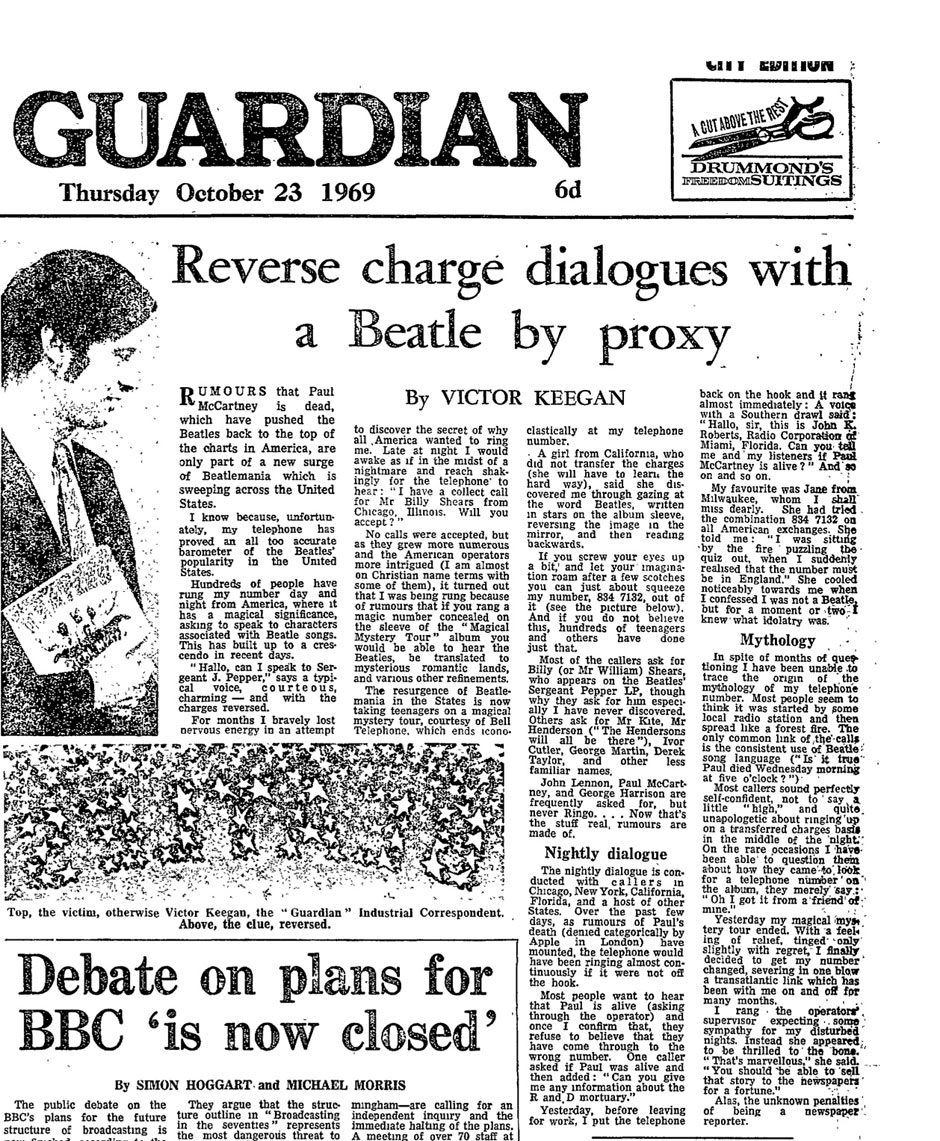
Victor Keegan's Guardian report on Beatle myths in 1969
Victor Keegan's Guardian report on mysterious phone calls from the US ... 

Monday, June 18, 2012

LftW: 18th June

Not many physics links this week, but plenty of other interesting stuff to make up for it.
  • Like most people I know, I have been following the football games at the current European Championship in Poland and Ukraine quite closely. Generally speaking the football has been very exciting, but there has also been some scrutiny of the venues for the games, and quite a bit of discussion about racism and anti-Semitism in both countries. A lot of this possibly stems from the history of the region; in The Observer, Michael Goldfarb wrote about the Ukrainian city of Lviv, formerly Polish Lwów, Russian Львов and German Lemsberg. A few days before that, The New York Review of Books had carried a review of a film about Lviv by Polish director Agnieszka Holland. Well worth reading both for some historical perspective.
  • On the topic of European political geography, there was a great YouTube video which went viral a couple of weeks ago, showing a time lapse of the changing political map of Europe from AD 1000 to 2006 in about 11 minutes, with notes about the main events and battles included. If, like me, you didn't know a great deal about the history of Europe but were fascinated by little tidbits such as the Spanish and Austrian dynasties being related, it was very educational. Unfortunately it has since been taken down by the copyright holders, so I can't link it here. Instead, you can have a look at the maps on this website, showing the boundaries at intervals of every hundred years, from AD 1  to the present. A poor substitute for the video, but pretty good nevertheless.
  • The British government's self-imposed austerity policy was always an unnecessary, ideologically motivated gamble, which several respectable economists opposed from the start. As it happens, events have proven their fears right, but the Conservatives have been reluctant to change course, because to do so would be openly admit their initial mistake. Nevertheless, George Osborne has been giving a big economic policy speech this week, in which Jonathan Portes catches him implicitly admitting that he was wrong and the Keynesians were right all along. There's more on this from the polite-but-scathing Simon Wren-Lewis, and the simply scathing Paul Krugman.
  • Germany will be playing Greece in the quarter-finals at the Euros in a few days, so perhaps it is worth recalling a previous game between these two nations (hat tip to Elton):
  • And finally, James Felce's blog post The War of The Immune Worlds at partner blog The Trenches of Discovery has made it to the semi-finals of 3 Quarks Daily's science writing competition. Worth a read!

Grexit followup

The Greek election looks like it will result in a victory for the current ruling coalition of New Democracy and Pasok, rather than for the more radical left-wing party Syriza. I get the feeling from reading various newspapers that there is a feeling of relief around Europe: the idea is that these parties will keep Greece following the austerity path and somehow avoid exit from the Euro, subsequent bank runs in Spain and then Italy, general chaos, global financial meltdown and so on and so forth.

Well, good luck of course. But informed economic opinion seems to be fairly unanimous that Greece will leave the Euro as a matter of necessity no matter whether they remain signed up to austerity or not. At most they will buying themselves a few months, but either way chaos is bound to ensue in Greece.

So this result is not really bad for Syriza at all. Euro exit, when it occurs, will now not be blamed on them, but on the austerity advocates. It is bad news for mainstream political parties, and undoubtedly we have not yet heard the last of the rise of the extremist parties in Greece.

The slow motion train crash continues in slow motion.

(Edit: After writing this I noticed that Paul Krugman says much the same thing on his blog. Probably not a complete coincidence!)

(New edit: So does Tim Duy.)

Wednesday, May 23, 2012

Grexit or not?

(Update: The Tim Duy post I linked to below has now been superseded by this report from him on the outcome of the meeting of Eurozone officials yesterday. He's still not happy!)

Over the last few months I have been following the continuing chaos in the Eurozone, much like everybody else in Europe who has a TV, radio or internet connection, I suppose. The spectre of a Greek exit from the Euro seems to have been dominating the front pages a lot more just recently, but most (or certainly most American) economists have been predicting this since about late 2010.

Anyway, this is a subject way outside my personal expertise, so I'm not going to make any comment of my own other than to say I find it darkly amusing that irresponsible borrowing is generally regarded as a far greater moral sin than irresponsible lending. What I will do is to provide some snippets of more expert opinions and share some links where you can read stuff to help you make sense of what's likely to happen in the next couple of months.

Monday, May 21, 2012

Links for the week: 20th May

I meant to put this out yesterday, but the supernova post took a bit longer to write than I was hoping. Anyway, here's a list of interesting links.

Physics links:
  • Last week I linked to a paper by Moni Bidin, Carraro, Mendez and Smith that claimed to have detected no evidence for dark matter affecting the kinematics of stars in the solar neighbourhood. I mentioned that this was not without controversy, and indeed this morning there was a new preprint by Bovy and Tremaine on the arXiv, who claim the Moni Bidin et al result is due to a key assumption that is not supported by the data. I haven't had time to read the paper yet, so I'll just quote from the abstract:
"We show that this result is incorrect and that it arises from the invalid assumption that the mean azimuthal velocity of the stellar tracers is independent of Galactocentric radius at all heights; the correct assumption -- that is, the one supported by data -- is that the circular speed is independent of radius in the mid-plane."
  • Suppose you have three upturned cups, and you are 90% certain that there is a ball under one of them. You turn two of them over and find no ball — how confident are you that the ball is under the third cup? Philip Gibbs gives a nice little argument illustrating Bayes' theorem, and uses it to argue that we shouldn't give up on SUSY yet.

Other links:

Tuesday, May 15, 2012

Links for the week - dark matter special

A longer blog posting should ready by the weekend, but is proving a little harder to write than I had hoped. In the meantime, here is a collection of interesting things to read elsewhere. I will make this sort of a roundup of worthwhile links a weekly feature on this blog, though it will make more sense to put it out at the weekend next time. Anyway, here you go:

Physics links:
  • Dark matter detection experiments have been in the news a lot recently. A couple of pre-prints have claimed to have seen some tentative evidence for a dark matter annihilation signal in gamma-ray data from the Large Area Telescope on the Fermi satellite, that somehow wasn't seen by the Fermi guys themselves. Matt Strassler discusses the first of these papers here. Rhys provides a nice short summary of both; you may also want to read a more bombastic discussion on Lubos Motl's blog.
  • The Cryogenic Dark Matter Search (CDMS) detection experiment earlier this year found no evidence for an annual modulation of dark matter interaction events in its detector, apparently contradicting earlier experiments DAMA and COGENT. A new pre-print from two members of COGENT claims CDMS mis-analysed their own data and there isn't a contradiction. (I'm not sure what to make of this: the argument seems pretty straightforward but I'm no expert so I might be missing some elementary things. Comments welcome!)
  • To make the story murkier still, this paper accepted by the Astrophysical Journal claims to find no evidence for dark matter in the solar neighbourhood based on the dynamics of stars in our galaxy, which would presumably rule out the possibility of direct detection. There are a number of caveats, so caution is advised: see here and Matt Strassler's post above. But then this paper, accompanied by this press release, makes an even more inflammatory claim about the non-existence of dark matter. Peter Coles provides a sceptical review (and entertaining arguments in the comments section!).
  • In case you are now thoroughly confused by the status of evidence for dark matter, Sean Carroll at Cosmic Variance gives us the transcript of a debate that sums up the main cosmological issues.
Phew, what a lot of dark matter. I realise some of the links above are not very recent — this blog is new and has some catching up to do! Now for other stuff.

Other links:
    • In the Guardian, Barney Ronay has a brilliant piece recalling an inspiring Olympic moment: Michael Johnson breaking the 200 m world record at Atlanta '96. If, like me, you watched the race at the time, you will have it forever seared in your memory. If not, here's a video: