Showing posts with label physics. Show all posts

Monday, February 3, 2014

Does the multiverse explain the cosmological constant?

At the end of the last post on falsifiability, I mentioned the possibility that the multiverse hypothesis might provide an explanation for the famous cosmological constant problem. Today I'm going to try to elaborate a little on that argument and why I find it unconvincing.

Limitations of space and time mean that I cannot possibly start this post as I would like to, with an explanation of what the cosmological problem is, and why it is so hard to resolve it. Readers who would like to learn a bit more about this could try reading this, this, this or this (arranged in roughly descending order of accessibility to the non-expert). For my purposes I will have to simply summarise the problem by saying that our models of the history of the Universe contain a parameter $\rho_\Lambda$ – which is related to the vacuum energy density and sometimes called the dark energy density – whose expected value, according to our current understanding of quantum field theory, should be at least $10^{-64}$ (in units of the Planck scale energy) and quite possibly as large as 1, but whose actual value, deduced from our reconstruction of the history of the Universe, is approximately $1.5\times10^{-123}$. (As ever with this blog, the mathematics may not display correctly in RSS readers, so you might have to click through.)

This enormous discrepancy between theory and observation, of somewhere between 60 and 120 orders of magnitude, has for a long time been one of the outstanding problems – not to say embarrassments – of high energy theory. Many very smart people have tried many ingenious ways of solving it, but it turns out to be a very hard problem indeed. Sections 2 and 3 of this review by Raphael Bousso provide some sense of the various attempts that have been made at explanation and how they have failed (though this review is unfortunately also at a fairly technical level).

This is where the multiverse and the anthropic argument comes in. In this very famous paper back in 1987, Steven Weinberg used the hypothesis of a multiverse consisting of causally separated universes which have different values of $\rho_\Lambda$ to explain why we might be living in a universe with a very small $\rho_\Lambda$, and to predict that if this were true, $\rho_\Lambda$ in our universe would nevertheless be large enough to measure, with a value a few times larger than the energy density of matter, $\rho_m$. This was particularly important because the value of $\rho_\Lambda$ had not at that time been conclusively measured, and many theorists were working under the assumption that the cosmological constant problem would be solved by some theoretical advance which would demonstrate why it had to be exactly zero, rather than some exceedingly small but non-zero number.

Weinberg's prediction is generally regarded as having been successful. In 1998, observations of distant supernovae indicated that $\rho_\Lambda$ was in fact non-zero, and in the subsequent decade-and-a-half increasingly precise cosmological measurements, especially of the CMB, have confirmed its value to be a little more than three times that of $\rho_m$.

This has been viewed as strong evidence in favour of the multiverse hypothesis in general and in particular for string theory, which provides a potential mechanism for the realisation of this multiverse. Indeed in the absence of any other observational evidence for the multiverse (perhaps even in principle), and the ongoing lack of experimental lack of experimental evidence for other predictions of string theory, Weinberg's anthropic prediction of the value of the cosmological constant is often regarded as the most important reason for believing that these theories are part of the correct description of the world. For instance, to provide just three arbitrarily chosen examples, Sean Carroll argues this here, Max Tegmark here, and Raphael Bousso in the review linked to above.

I have a problem with this argument, and it is not a purely philosophical one. (The philosophical objection is loosely the one made here.) Instead I disagree that Weinberg's argument still correctly predicts the value of $\rho_\Lambda$. This is partly because Weinberg's argument, though brilliant, relied upon a few assumptions about the theory in which the multiverse was to be realised, and theory has subsequently developed not to support these assumptions but to negate them. And it is partly because, even given these assumptions, the argument gives the wrong value when applied to cosmological observations from 2014 rather than 1987. Both theory and observation have moved away from the anthropic multiverse.

Wednesday, January 22, 2014

Is falsifiability a scientific idea due for retirement?

Sean Carroll argues that it is.

He characterises the belief that "theories should be falsifiable" as a "fortune-cookie-sized motto"; it's a position adopted only by "armchair theorizers" and "amateur philosophers", and people who have no idea how science really works. He thinks we need to move beyond the idea that scientific theories need to be falsifiable; this appears to be because he wants to argue that string theory and the idea of the multiverse are not falsifiable ideas, but are still scientific.

This position is not just wrong, it's ludicrous. 

What's more, I think deep down Sean – who is normally a clear, precise thinker – realises that it is ludicrous. Midway through his essay, therefore, he flaps around trying to square the circle and get out of the corner he has painted himself into: a scientific theory must, apparently, still be "judged on its ability to account for the data", and it's still true that "nature is the ultimate guide". But somehow it isn't necessary for a theory to be falsifiable to be scientific.

Now, I'm not a philosopher by training. Therefore what follows could certainly be dismissed as "amateur philosophising". I'm almost certain that what I say has been said before, and said better, by other people in other places. Nevertheless, as a practising scientist with an argumentative tendency, I'm going to have to rise to the challenge of defending the idea of falsifiability as the essence of science. Let's start by dismantling the alternatives.

Tuesday, May 21, 2013

One year on

It has been a long month-and-a-bit since I last had the time to write a proper post here. Primarily this is because I am not very good at doing more than one thing at a time – at least while attempting to do those things properly – and I have been working on some real research papers, which I thought I should try to do properly. As a result science communication, and blogging in general, has had to wait. But I will get back in the swing of things very soon: there are some interesting new results, some interesting rehashes of old arguments about inflation, and one of my own papers that I will write about over the next couple of weeks.

One of the many things that I omitted to mention during this little break was the fact that Blank On The Map had its first anniversary a couple of weeks ago. All in all, I would say it has been quite a satisfying year of blogging, and, at least relative to my prior expectations, a reasonably successful one too. Blogger doesn't provide me with many detailed statistics, but it does tell me that despite the low recent rate of new postings, there have been roughly 23,000 clicks over the last twelve months. A sizeable portion of of this traffic came from one link on Peter Woit's blog (boy he must have a huge number of readers!) – though the majority appear to arrive via Google search, either by accident or design.

Anyway, to all those who have arrived here at some point over the last year, welcome! I hope you found what you were looking for, and enjoyed what you read. This explains what this blog is about. In case you haven't worked your way through the archives, here is a short selection of some highlights from the last year:


I should also use this post to try to get some feedback from (all three) regular readers. Do you think I should post more often? Less often? More posts about cosmology and fewer about mountaineering and other stuff in general? Or the other way round? Let me know through the comments box. Constructive criticism of the writing style or any other aspect of this blog will also be well received, though I can't promise to change ...

Tuesday, March 19, 2013

A real puzzle in cosmology: part II

(This post continues the discussion of the very puzzling observation of the integrated Sachs-Wolfe effect, the first part of which is here. Part II is a bit more detailed: many of these questions are real ones that have been put to me in seminars and other discussions.)

Update: I've been informed that one of the papers mentioned in this discussion has just been withdrawn by the authors pending some re-investigation of the results. I'll leave the original text of the post up here for comparison, but add some new material in the relevant sections.

Last time you told me about what you said was an unusual observation of the ISW effect made in 2008.

Yes. Granett, Neyrinck and Szapudi looked at the average CMB temperature anisotropies along directions on the sky where they had previously identified large structures in the galaxy distribution. For 100 structures (50 "supervoids" and 50 "superclusters"), after applying a specific aperture photometry method, they found an average temperature shift of almost 10 micro Kelvin, which was more than 4 standard deviations away from zero.

Then you claimed that this observed value was five times too large. That if our understanding of the universe was correct, the value they should have seen should not have been definitely bigger than zero. Theory and observation grossly disagree.

Right again. Our theoretical calculation showed the signal should have been at most around 2 micro Kelvin, which is pretty much the same size as the contamination from random noise.

But you used a simple theoretical model for your calculations. I don't like your model. I think it is too simple. That's the answer to your problem – your calculation is wrong.

That could be true – thought I don't think so. Why don't we go over your objections one by one?

Tuesday, March 5, 2013

A real puzzle in cosmology: part I

In a previous post, I wrote about recent updates to the evidence from the cosmic microwave background for extra neutrino species. This was something that a lot of people in cosmology were prepared to get excited about, but I argued that reality turned out to be really rather boring. This is because the new data neither showed anything wrong with the current model of what the universe is made of, nor managed to rule out any competing models.

Today I'd like to write about something else, which currently is a really exciting puzzle. Measurements have been made of a particular cosmological effect, known as the integrated Sachs-Wolfe or ISW effect, and the data show a measured value that is five times larger than it should be if our understanding of gravitational physics, our model of the universe, and our analysis of the experimental method are correct. No one yet knows why this should be so. The point of this post is to try to explain what is going on, and to speculate on how we might hope to solve the puzzle. It has been written in a conversational format with the lay reader in mind, but there should be some useful information even for experts.

Before beginning, I should point out that this what a lot of my own research is about at the moment. In fact, this was the topic of a seminar I gave at the University of Helsinki last week (and much of this post is taken from the seminar). My host in Helsinki, Shaun Hotchkiss, with whom I have written two papers on this "ISW mystery", has also put up several posts about it at The Trenches of Discovery blog over the last year (see here for parts I, II, III, IV, V, and VI). I will be more concise and limit myself to just two!

Obviously you could view this as a bit of an effort at self-publicity. But at a time when, both in particle physics and cosmology, many experiments are disappointingly failing to provide much guidance on new directions for theorists to follow, this is one of the few results that could do so. (Unlike a lot of the rubbish you might read in other popular science reports, it also has a pretty good chance of being true.) So I won't apologise for it!

What is the integrated Sachs-Wolfe effect?

The entire universe is filled with very cold photons. These photons weren't always very cold; on the contrary, they are leftovers from the time soon after the Big Bang when the universe was still very young and very small and very hot, so hot that all the protons and electrons (and a few helium nuclei) formed a single hot plasma, the photons and electrons bouncing off each so often that they all had the same temperature. And as the universe was expanding, this plasma was also cooling, until suddenly it was cool enough for the electrons and protons to come together to form hydrogen atoms, without immediately getting swept apart again. And when this happened, the photons stopped bouncing off the electrons, and instead just continued travelling straight through space minding their own business, cooling as the universe continued to expand. (The neutrinos, which only interact weakly with other stuff, had stopped bouncing and started minding their own business some time before this.)

What I've just told you is a cartoon picture of the history of the early universe. These cooling photons streaming through space form the cosmic microwave background radiation, or CMB for short. They fill the universe, and they arrive at Earth from all directions – they even make up about 1% of the 'snow' you see on an (old-school) untuned TV set. 

The most important property of the CMB photons is that, to a very great degree of accuracy, they are all at the same temperature, whichever direction they come from. This is how we know that the universe used to be very hot, and how we learned that it has been expanding since then. It is also why we think it is probably very uniform. The second important property of CMB photons is that they are not all at the same temperature – by looking carefully enough with an extremely sensitive instrument, we can see tiny anisotropies in temperature across the sky. These differences in temperature are the signs of the very small inhomogeneities in the early matter-radiation plasma which are responsible for all the structure we see around us in the night sky today. When the photons decoupled from the primordial plasma, they kept the traces of the tiny inhomogeneities as they streamed across the universe. The matter, on the other hand, was subject to gravity, which took the small initial lumpiness and over billions of years caused it to become bigger and lumpier, forming stars, galaxies, clusters of galaxies and vast clusters of clusters.

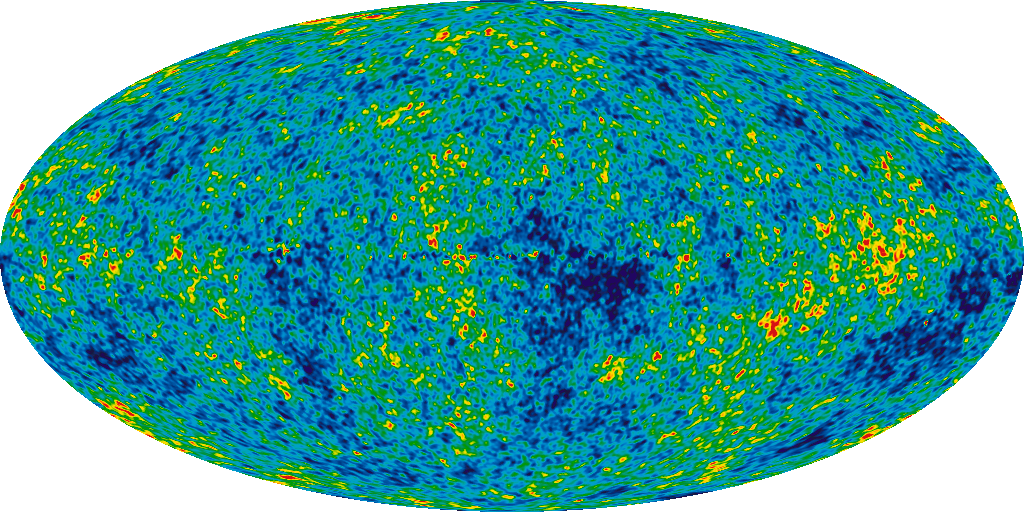
The CMB sky as seen by the WMAP satellite. The colours represent deviations of the measured CMB temperature from the mean value – the CMB anisotropies (red is hot and blue is cold). This map uses the Mollweide projection to display a sphere in two dimensions. Image credit: NASA / WMAP Science team. 

Yes I knew that, but what is the integrated Sachs-Wolfe effect?

Tuesday, February 12, 2013

Seeing neutrinos in the CMB

One of the really cool things about cosmology is the fact that you can look at the sky and use the cosmic microwave background to determine that there must be at least three generations of neutrinos, without having directly observed them in any ground-based experiments.

Well, actually we already knew that there were at least three neutrino generations from ground-based experiments before we had anywhere near the technological capability to determine this from the CMB, but it's arguably still pretty cool. What would inarguably be pretty amazing is if we could use CMB observations to prove that there were further, yet-undiscovered, generations of neutrinos that we could then go and look for elsewhere. Or, for a particular type of person, it might be quite satisfying to use the CMB to prove that there definitely weren't any more than the three generations we already know about, thus killing a lot of other people's pet theories stone dead.

All this is (somewhat) topical because of the release of new data from three experiments measuring the CMB: the Wilkinson Microwave Anisotropy Probe (WMAP) satellite, the Atacama Cosmology Telescope (ACT) and the South Pole Telescope (SPT), that could in principle do something like this. Given my various recent blogging delays, however, I haven't been particularly quick about writing about this, and there are other good discussions elsewhere on the web, especially at Résonaances, that many readers will already have seen. I'm also afraid I don't have time for a layperson-level introduction to the topic right now. But there's a bit of a jumble of information from the different collaborations, some of it mildly contradictory, and in this post I'd like to – partly simply as a note for myself – summarise it all and sort it into a logical order.

In case you'd like to just see the executive summary, it is that – in my opinion – the new data doesn't tell us anything very interesting. For a fuller justification of this statement, keep reading.

Thursday, January 31, 2013

Type Ia single degenerate survivors must be overluminous

I noticed a paper on the arXiv today with exactly this title (well, except that I removed the superfluous capitalisation of words), that is due to be published in the Astrophysical Journal. The abstract of the paper says:
In the single-degenerate (SD) channel of a Type Ia supernovae (SN Ia) explosion, a main-sequence (MS) donor star survives the explosion but it is stripped of mass and shock heated. An essentially unavoidable consequence of mass loss during the explosion is that the companion must have an overextended envelope after the explosion. While this has been noted previously, it has not been strongly emphasized as an inevitable consequence. We calculate the future evolution of the companion by injecting $2$-$6\times10^{47}$ ergs into the stellar evolution model of a $1\,M_\odot$ donor star based on the post-explosion progenitors seen in simulations. We find that, due to the Kelvin-Helmholtz collapse of the envelope, the companion must become significantly more luminous ($10$-$10^3\, L_\odot$) for a long period of time ($10^3$-$10^4$ years). The lack of such a luminous "leftover" star in the LMC supernova remnant SNR 0609-67.5 provides another piece of evidence against the SD scenario. We also show that none of the stars proposed as the survivors of the Tycho supernova, including Tycho G, could plausibly be the donor star. Additionally, luminous donors closer than $\sim10$ Mpc should be observable with the Hubble Space Telescope starting $\sim2$ years post-peak. Such systems include SN 1937C, SN 1972E, SN 1986G, and SN 2011fe. Thus, the SD channel is already ruled out for at least two nearby SNe Ia and can be easily tested for a number of additional ones. We also discuss similar implications for the companions of core-collapse SNe.
Now, technical scientific papers are full of jargon and maybe the meaning of that paragraph isn't immediately clear to everyone (there's an accompanying Youtube video purporting to explain the content of the paper, but I didn't think it quite achieved that aim!). But I think this result is really quite interesting and probably important in a broader cosmological sense.

Thursday, January 17, 2013

New directions in a new year

Although we are already more than half-way through January, I'd like to say happy 2013 to all readers of this blog! Better late than never.

It won't have escaped the attention of regular visitors that the rate of posting new items here has significantly declined over the last few months, as exemplified by the belated new year's greetings. There is a good reason for this. It isn't that I haven't thought of any things to write about; on the contrary, I have had lots of ideas, but not enough time to write them up. Instead the hiatus has primarily been because I have been applying for a new postdoctoral job starting this coming October, and writing tailored job applications is an incredibly time-consuming process — much the same as in non-academic jobs, I suppose, though with the added annoyance that all the time spent writing in detail about what wonderful research you would do if hired is time not spent actually doing any research. Between those two competing claims for my attention and all the rest of real life, there was no time at all left for blogging.

However, the result of all this time spent applying is that I have now been offered, and accepted, a 2-year postdoc position to start in October at the University of Helsinki, in the group of Kari Enqvist. I have to say, I am very pleased about this, and not only because it means I needn't spend any further time on applications! In fact from a previous visit there, I know that the atmosphere in the Helsinki research group is one that I will enjoy very much.

I understand that to people outside academic physics circles, applying in about November (in fact some deadlines this year were even slightly earlier) for a job due to start fully 11 months later might seem a little odd. But that is the way the system works, and it probably isn't the only odd thing about physicists anyway. On the bright side though, it does mean that — as in this case — the question of where in the world one is moving to can all be settled by January, leaving plenty of time to plan the move, both in academic and purely logistical terms.

Anyway, now that this business is over, you can expect to see a slightly improved rate of posting here.

Tuesday, December 11, 2012

More new physics prizes

The news today in physics, reported by the New York Times and Peter Woit, is that Yuri Milner, the Russian billionaire physics enthusiast, has announced a new set of prizes for fundamental physics. I wrote a little about the previous award of prizes here. These prizes are somewhat less generous than those announced over the summer (which were worth \$3 million each); this time only Stephen Hawking receives that amount, and the others get a smaller share. Woit typically notes that almost all the non-experimental recipients have some connection to string theory.

But the other interesting thing about the new prizes is that in this round, some experimentalists have actually been included. Of course all of them are involved with the LHC at CERN: no surprise there, given Milner's personal interests in physics.

What I do find rather noteworthy, however, is the way in which the prizes have been divided. $1 million is to be divided between the current and former ATLAS spokespersons Fabiola Gianotti and Peter Jenni, and another million between CMS current and ex-spokepersons Joe Incandela, Michel Della Negra and Tejinder Virdee. Now I'm not very knowledgeable about the organisational structure or the division of labour in these experiments, but each experiment has roughly 3000 scientists working on it and everything I had read about them in relation to speculation about a possible Nobel award suggested that there was no real way to single out the contribution of any individuals out of these thousands as being especially more worthy than any other.

It does appear that Milner has found a way to do this though: pick the spokesperson elected by the experiment. Now I wonder what the reaction to this is at ATLAS and CMS. Is this regarded as fair? Do the spokespersons really make a bigger contribution to the discovery of the Higgs? I really don't know but I'd be interested to learn what people think. I know some of the readers of this blog are part of the ATLAS and CMS collaborations — if any of you have an opinion, please do share it through the comment box!

Update: Via Shaun in the comments, there is interesting news about what the current spokespersons intend to do with their money. Also, Tommaso Dorigo gives his opinion on the matter here; I have to say my views are rather more in line with those expressed in the comment by Bernhard on that blog.

Less serious update: An anonymous friend in the ATLAS group says "I can't believe Fabiola has had her choice of font vindicated in this way."

Thursday, November 22, 2012

The Structure of a Scientific Revolution

A few days ago, Peter Coles posted an interesting comment about skepticism on his blog. In it, he showed the first graphs with data showing evidence for the acceleration of the expansion of the Universe from observations of distant supernovae. His point was that though the plot isn't much to look at, the statistical evidence for cosmic acceleration from supernovae data was quickly established and very soon became very widely believed.

Coles goes on to make some points about global warming skepticism, and most of the long discussion in the comments that follow is concerned with this. Which is unfortunate, as none of that discussion provides an exception to the general rule that arguments about global warming are a complete waste of time, because people have already decided what they want to believe before they start, and are subsequently impervious to any evidence, logic or persuasion. So although you may want to read the discussion there, let's not talk about the climate here.

Instead, I want to stick with the cosmology and pick up on a question that is more interesting. Let's take a quick look at the picture of the supernovae data from the High-Z Supernova Search Team and the Supernova Cosmology Project:
Evidence for dark energy from the Hubble diagram of supernovae. The top panel shows the distance modulus of the supernovae as a function of redshift, with three different theoretical model curves. The bottom panel shows the residual distance modulus relative to that in the model with the dotted curve (a Milne universe).
As Coles points out, most people who are not cosmologists (and some who are) look at these data and find them deeply unconvincing. The error bars are large. The points are widely scattered, and at least both the top two curves seem to give reasonably good fits. On top of that, there appear to be two distinct groups of supernovae: one group rather close to us, and the other much further away at higher redshifts (and therefore observed as they were a long time ago). Any inferences we draw from relative calibrations of these two groups rest on the assumption that deep down they are the same kind of objects, and that the Universe they existed in remained the same kind of Universe.

So why exactly did this cause such a revolution in the field? How did so many physicists become convinced, almost overnight, of the existence of this mysterious dark energy, that constitutes most of the energy of the Universe, but that we didn't understand then and don't understand now?

Saturday, September 8, 2012

Why are plants green?

Yes, I know, because chlorophyll is green. But why is that? This is a genuine question, so if any readers of this blog can answer it for me, I'd be grateful.

Let me explain a bit more. Yesterday I stumbled across an old post by Peter Coles asking why the Sun isn't green. If you haven't wondered this before, you should have a read. The reason for asking is that the intensity of light emitted by the Sun — which is very similar to a blackbody spectrum at a temperature of close to 6,000 Kelvin — peaks at the wavelengths associated with green.
Some example blackbody spectra. The Sun's surface temperature is about 5,800 K.
Naively therefore one might expect the Sun to appear green, rather than the colour it does, which is ... white (depending a little on where it is in the sky).

I won't explain here why the Sun doesn't appear green, or indeed why we don't see any green stars at all, because that's been done very well elsewhere on the internet. In particular you might want to check out this video explanation. As perhaps you might have suspected, the answer is less to do with physics than with biology of the human eye.

In fact, it's quite easy to come up with a simple ex post facto rationalisation of why we should have evolved so as to perceive sunlight as neutral white colour. 'White', after all, is a somewhat vague and flexible concept, as anyone who has operated a digital camera would know.

But in light of this, what I don't have such a simple explanation for is the fact that plants are green. Chlorophyll appears green because it uses light from the red and blue parts of the spectrum to power photosynthesis, and reflects green wavelengths. But why has it evolved in such a way as to reject precisely that part of the solar spectrum where the intensity of light is highest? Would it not have conferred an evolutionary advantage to make better use of this incident energy?

As I said, I don't know the answer to this little puzzle. Perhaps the explanation comes from chemistry — maybe there is simply some restriction on the possible chemical pathways by which CO2 and H2O can be converted into organic molecules, which all evolutionary variants would have to respect, and which renders light of certain frequencies unsuitable. Or perhaps it comes from some quirk of evolutionary history — one of those little inefficiencies that occur due to historical accident, and which are themselves evidence for the action of evolution, like the panda's thumb.

Either way, if you know the answer or can hazard a guess at it, please do tell me.

Thursday, August 30, 2012

The largest patterns in the Universe

In addition to the developing series of posts on probability and statistical inference, I also want to write another series discussing the patterns in the distribution of galaxies, clusters of galaxies and dark matter in the Universe: how we reconstruct these patterns from observation, and how we can use this information to learn about the very distant past back near the time of the Big Bang some 14 billion years ago. This is what much of my day-to-day research is about, so I can claim more expertise on this subject than on some of the others I post about.

I'll try to keep the majority of the discussion at a level suitable for readers with an interest in cosmology, but no detailed technical knowledge of it, though I hope to include enough information to interest more expert readers as well. However, rather than constructing a systematic development of ideas from first principles I'm afraid I will flit about like a butterfly, alighting on topics that are of particular interest to me at the moment! Questions and feedback are welcome via the comments box.

Today's post is about the homogeneity of the distribution: the absence of pattern.

Saturday, July 28, 2012

Things to Read, 28th July

Physics items:
  • New results are in from the dark matter search at the XENON100 detector in Gran Sasso in Italy. See here for technical slides, or read the summaries at Quantum Diaries or Cosmic Variance. Basically, they see no dark matter events above the background expectation, so the exclusion limits on WIMP mass and cross-section are extended. As Sean Carroll points out, the results appear to be in some tension with some other experiments, but these things depend on theoretical assumptions about the nature of dark matter.
  • In the Guardian, Jon Butterworth muses about the 'impact' of the discovery of the Higgs, and on the usefulness of 'impact' in general as a guide for deciding what scientific research to fund. There are some worthwhile points there, especially about who should get to decide which science has an 'impact' and which not. But I felt on some issues the piece was rather confused — he first seems to suggest that "a sense of progress" and the satisfaction of simply "adding to the body of human knowledge" are sufficient justification for funding fundamental research that may have no other forseeable benefit, but later says he disagrees with the statement that "the acquisition of knowledge is somehow morally or intellectually superior to the application or dissemination of knowledge". So which is it?
    I wrote about my own views on the justification for funding science research that has no obvious economic, medical or social payoff here. I do think it is justifiable, even if one can safely predict that there will never be any direct benefits from such research (serendipitous spin-offs, like the common examples of the internet or MRI, are a separate issue, but cannot be guaranteed). So it annoys me to see people constantly trying to justify studying the Higgs boson in terms of what hypothetical technological advances it might bring. Face it, there won't be any — if you don't believe me, here is Steven Weinberg saying much the same (among other interesting things!), or click here to see just how hard it is to come up with any remotely plausible technological speculations consistent with known physics.
    The point is that there already exist good enough reasons for funding fundamental research, so let's leave out all the rubbish about Higgs-powered spaceflight and so on, shall we?
  • Readers may have already seen elsewhere the story of the physicist Paul Frampton, who has been in an Argentine jail for several months, facing charges of drug smuggling. It's a sad and frankly incredible story; I see (via Peter Woit) that Frampton expects he might be released soon (though he's been wrong about this before).
Other items:
  • There is a fantastic super-slow-motion video of a lightning strike, shot at 7207 frames per second, available here, with a nice little explanation of the mechanism of the strike. I'd highly recommend it!
  • A Canadian wonders whether the Euro is worth saving at all.
  • Is there a magic button for the UK government to press? Do they want to press it?
  • On a more cheerful note, some time ago Peter Coles posted Patrick Barrington's lovely comic poem I Had A Hippopotamus. It begins like this:
    I had a hippopotamus; I kept him in a shed
    And fed him upon vitamins and vegetable bread.
    I made him my companion on many cheery walks,
    And had his portrait done by a celebrity in chalks.

    His charming eccentricities were known on every side.
    The creature’s popularity was wonderfully wide.
    He frolicked with the Rector in a dozen friendly tussles,
    Who could not but remark on his hippopotamuscles.

    [...]
    Barrington's best known poem The Diplomatic Platypus is also great fun (and has a strangely similar theme).

Saturday, July 21, 2012

How to update your beliefs in light of new evidence

This post is the second in a series on probability and statistical inference, and follows this one, in which I asked readers a question that I had once put to applicants to Oxford in physics interviews. If you have not yet answered the question in the poll, you should click on the link above and try it first! The poll will remain open for anyone who would like to try answering the question before reading the answer below.

Sunday, July 15, 2012

A question of probability

In my post today, I'd like to ask readers of this blog a little question on probability that we* used a few years ago as an interview question for Oxford physics admissions.

The Oxford interview process is quite famous — or notorious, depending on your point of view — in the UK, and every year, come admissions time, newspapers run stories containing collections of "impossible" or eccentric questions that have supposedly been asked of candidates by malicious interviewers. In some newspapers the slant then given to the story is that the entire interview process is, by design or by coincidence, weighted against applicants from state schools, who are less well prepared for such shocks and are reduced to nervous wrecks.

I don't wish to enter into such a political discussion here, but in case any prospective interview candidates were to read this blog post I'd like to assure them that the interviews — at least in physics and at least in my experience — are certainly not like this. Interviewers realise that nervous applicants do not reflect their true potential, so they do not deliberately add to the tension and will in most cases attempt to create as relaxed an atmosphere as possible. They also realise that interviews, because of their highly subjective nature, are statistically not very good indicators of the true physics ability of the student. It is well-known that performance in the physics aptitude test applicants are required to take is a better predictor of their subsequent performance when at Oxford, so test results are substantially weighted up relative to interview scores when making decisions on who to admit. (You're also probably better off reading Oxford's own guide to sample interview questions than anything in the press!)

Anyway, I digress. The point of this post was the question of probability, not a discussion of admissions procedures. I thought the question was quite a nice one, but as it turned out no interviewees answered it correctly when it was first put to them, and after being given a gentle hint or two, almost all of them got to the right answer. So it was pretty useless at distinguishing between applicants and as a result not a very successful interview question. On top of that, I've also recently discovered that it is explained in great detail in a best-selling popular book on probability, so it probably won't be used again — which is why I feel it is safe to disclose it here! So here it is, slightly reworded:
You learn about the existence of some rare disease, X, which is known to affect 1 in every 10,000 people. Being a bit of a hypochondriac, you are afraid that you may have disease X, so you go to your doctor for a blood test. The doctor tells you that the test for this disease is accurate 99.9% of the time. To your horror, the test result comes back positive. What is the probability you have disease X?
I won't give the answer immediately (update: the answer is now explained here), because I'd first really like to know how readers of this blog would answer it. So I'd like to encourage everyone who reads this post to vote in the following poll -

What is the likelihood you have disease X?

Please don't be shy about voting! If you get it wrong, well, you've done no worse than some of the brightest A-level students in the UK. On the other hand, you could have the satisfaction of getting it right and displaying your knowledge to the world (the poll's completely anonymous, but still). Feel free also to comment on this post, but please don't give the answer away if you know it.

The reason that I've posted this question and the reason I'd like to know people's answers is that although it wasn't a good interview question, I think it is still a good way to get people to think about probability, and the question of how to deduce information from limited evidence. These are topics which I would like to discuss in a series of further posts over the next few weeks, so I'll use this as a starting point.

* I took part in admissions interviews between 2007 and 2010 as part of a tutoring job while finishing my doctorate. This particular question was one suggested by my (senior) colleague for use in one of those years.

Monday, July 2, 2012

LftW: 2nd July

Physics links:
  • The important physics event of the next week will be the CERN press conference on the Higgs search analyses coming up on Wednesday at 9 am CEST. Peter Woit provides a preview, summarising what we might expect to hear. At Quantum Diaries, Aidan Randle-Conde explains why we might not want to combine the significances of detection obtained from ATLAS and CMS in order to obtain the magical "5 sigma" standard for detection. The official results probably won't provide a combined significance for this reason, but doubtless various bloggers and others will do so.
  • On the day itself, this blog will not be the best place to get your news. Instead, you might wish to go here, or to one of the other links down the right-hand panel.
  • On Friday, there was an intriguing paper uploaded to the arXiv, proposing a new type of dark matter detector made out of gold foils and single-stranded DNA. I don't know what to make of this paper: it sounds a little crazy, but then I don't know much about the molecular biology of using ssDNA. Two of the physicist authors — Katherine Freese and David Spergel — are well-known, serious scientists. I presume the other authors are biologists.
  • Peter Coles put up a nice set of "order-of-magnitude" physics problems to have a go at, including for instance "How much brighter is sunlight than moonlight?"
Other links:
Victor Keegan's Guardian report on Beatle myths in 1969
Victor Keegan's Guardian report on mysterious phone calls from the US ... 

Tuesday, June 26, 2012

More Thoughts on Peer Review

This morning I saw a new blog post by Peter Coles dealing with a topic I have written about before: the problems with the current system of scientific peer review. He too has strong opinions on the subject, which he has expressed several times on his blog. For the most part, I think our shared disgruntlement with the system stems from the same source — academic publishers trumpeting Peer Review (capitals intentional) as some sort of absolute certificate of quality that only they are able to provide, and provide at an exorbitant cost at that, whereas in fact not only it can probably be organised far more cheaply, the current system isn't all that hot at sorting out the wheat from the chaff anyway.

Coles takes a particular example of a paper recently published in the Astrophysical Journal in order to illustrate his point. The authors make a strong claim — the sort of strong claim that requires watertight evidence to back it up — and yet a key figure in the paper relies on interpreting a curve, which is supposed to be a cubic spline interpolation of the data, that passes through only two data points. Where are the other data points? Presumably they exist, but they aren't displayed in the figure. At the very least this is sloppy and unhelpful to anyone trying to reproduce the results, and the referee should have asked for a modification. But referees are often sloppy and distracted themselves; when there is only one referee to pass judgement on the merits of a paper the outcome of Peer Review should really be taken with a giant pinch of salt.

(I should point out that I have no idea whether this paper was reviewed by only one referee; most of the journals I am familiar with tend to run a default single-referee policy, but the Astrophysical Journal may be different. However, I have noticed several papers accepted to the Astrophysical Journal recently that in my opinion suffer from similar sloppy faults, one of which I blogged about here.)

Anyway, if the system of peer review is faulty in this manner, what should be done about it? I argued that at a minimum, journals should publish the correspondence between the referee and the editor, and the authors' responses to criticisms. This would help to highlight the cases of sloppy negative reviews, such as the instances, pointed out in a comment by Sarah, of referees simply requesting changes that are already included in the manuscript (sadly this happens quite a lot, in my experience). It would put some pressure on journal editors to improve the standard of refereeing in order to protect reputations, and make it obvious when a paper has only been reviewed by one individual. It wouldn't do a great deal to deal with sloppy positive reviews, leading to the acceptance of papers of the sort that Coles is complaining about today.

Coles' own solution is to do away with Peer Review by one or two individuals altogether, and instead have a sort of community rating system on the arXiv itself, along the lines of reddit:
I’m not saying the arXiv is perfect but, unlike traditional journals, it is, in my field anyway, indispensable. A little more investment, adding a comment facilities or a rating system along the lines of, e.g. reddit, and it would be better than anything we get academic publishers at a fraction of the cost. Reddit, in case you don’t know the site, allows readers to vote articles up or down according to their reaction to it. Restrict voting to registered users only and you have the core of a peer review system that involves en entire community rather than relying on the whim of one or two referees. Citations provide another measure in the longer term. Nowadays astronomical papers attract citations on the arXiv even before they appear in journals, but it still takes time for new research to incorporate older ideas.
I agree with the sentiment, but in the interest of fairness I should point out a couple of objections. Firstly, clearly only some papers will get reviewed this way. Many perfectly correct papers will be ignored simply because they are not on currently fashionable topics. Although writing papers that are of current interest to your fellow scientists is of some importance, it shouldn't be the sole criterion for judging merit!

Secondly, simple votes up or down are not particularly useful to a reader: if I am to trust the judgement of the people voting on the quality of a paper I'd really need to read a justification from them of why they voted in a particular way. This would amount to a mini-review of the paper and its strong (or weak) points. Such reviews would need to be provided anonymously — by the registered users of the site — in order ensure that people felt secure enough to express honest opinions. Non-anonymous review systems would I think inevitably dwindle into relative irrelevance like Cosmo Coffee has done, but completely anonymous systems would probably develop into flame wars in the classic tradition of the internet (at least with the current system the identity of the referee is known to the journal editor if no one else!).

I'd like to hear further comments from interested and informed readers. Perhaps a perfect system isn't possible, but I'm sure there are improvements which can be made to the current model. And even if that isn't the case, I think the moral you should draw from the story is that not all that is published is gold, not all those who aren't are lost. Or something more poetically phrased than that!

Saturday, June 2, 2012

An explanation of the recent dark matter controversy

About two weeks ago, I mentioned a recently published paper by Chilean authors Moni Bidin et al., claiming to have found no evidence for dark matter around our local neighbourhood in the Milky Way. Very soon afterwards, I pointed out a new pre-print by Bovy and Tremaine that rebutted this claim. Although I suppose I was fairly quickly on the scene, I wasn't particularly happy with the way I had reported this argument: just mentioning that some people disagree with each other without any explanation of the reasons is a bit closer to mere journalism than I was intending.

Since then, there have been several blog posts on this issue elsewhere — see Résonaances, Peter Coles, Matt Strassler and Sean Carroll among others — but to be honest I didn't think they actually did much more than report that people disagreed with each other either (although many of them did add some sociological comments). Which is fine as far as it goes, but if you were looking for someone to explain the science to you, you might have been disappointed. Jon Butterworth at least made a commendable effort in his Guardian blog, but he was perhaps limited by space and an inability to include any mathematics. In the end he simply said that he believed the Bovy and Tremaine result because Peter Coles believed it (and Peter Coles essentially told us to believe it because Scott Tremaine is an acknowledged world expert in galactic dynamics). Which is all very good and probably correct, but not very enlightening!1

So eventually I've decided to fill this gap in the market myself: this post will attempt to summarise and explain both papers to a non-expert (i.e. anyone who doesn't actually work in the field of galactic dynamics). A major caveat before I start: I don't work in galactic dynamics either. I don't own, and had never read, the main reference work on this subject (by Binney and Tremaine; you see why people might trust Tremaine to be right on this one!). In preparation for writing this post I borrowed a copy and read a small amount of it — enough to feel I understood what was going on — but even so much of what I am about to write might be over-simplified, misrepresented or simply wrong. If you happen to spot any mistakes, please let me know.

Now that we've got that out of the way, let's start.

Tuesday, May 29, 2012

Can peer review be improved?

Last week I was back in Oxford briefly and visited my DPhil supervisor Subir Sarkar, who, in the course of a long conversation about various things, told me about a discussion he had apparently had with Professor Anton Zeilinger after a recent colloquium there. Zeilinger had apparently mentioned the academic peer review process and had some ideas about how the process might be made to serve science better by being more transparent. I found these ideas (as relayed to me) rather thought-provoking, and I'd like to promote a bit of discussion about them on this blog.

To paraphrase the argument: an important problem with the peer review system as it stands is that in many (or even most) cases there is only one referee who decides whether the submitted paper meets the scientific standards of the journal in question, this referee is completely anonymous, and his or her report on the paper remains entirely confidential, seen only by the journal editor and the author(s) of the paper in question.

Guaranteed anonymity is well known to alter people's behaviour on the internet, in general making people more opinionated, far ruder, and less receptive to reasoned discussion about alternative points of view. Unfortunately, scientists being only human, this is almost certainly also true to some extent in the peer review process. So removing the referee's anonymity might well improve civility in some cases, and you can see why senior academics might be in favour of it — though I notice that my feeling that even anonymous reviewers are more polite when the corresponding author on a paper is a senior figure rather than a graduate student or young postdoc seems to be shared by some others, so senior academics should have the least to complain about.

Removing referee anonymity is not a completely crazy idea: I'm told it is the norm in Scandinavian countries for the identity of the panels reviewing grant proposals to be known to applicants — though here there is some aspect of collective responsibility, within the panel there may only be a single expert on a particular field, so in practice this doesn't offer a lot of cover. If all authors and reviewers were perfectly objective, with no tendency to personal animosity or desire for retribution, and all had the same permanent job security, it might work. But they aren't, and they don't, so it can't. In particular, much reviewing is actually done by younger scientists, postdocs at the start of their careers, who may well one day be applying for a job to the author whose paper they are reviewing. The potential conflicts of interest don't bear thinking about. I'm pretty sure referees must remain anonymous.

Similarly, it is impractical to demand several referees for each submitted paper. In physics a few, very high profile, journals do use multiple referees, but usually only for short papers in a Letter format (i.e., less than about 5 pages long). Having more than one referee for each full-length paper at each journal would presumably increase the time taken to accept or reject submitted papers to unacceptable levels.

What about the third option? Why can't journals put a link next to the online version of accepted papers, that allows those interested to read the correspondence between the authors and the (still completely anonymous) referee? Knowing this correspondence was to be made public might cause referees (and, equally importantly, authors replying to the referee's criticisms!) to be far more civil. It would certainly help put an end to the unfortunate but not-entirely-unknown incidents of referees holding up publication on specious grounds until certain citations are added to the manuscript. I think it would also raise the level of debate. Journals of course would only provide such a summary of correspondence for accepted papers, but authors could perhaps, if they felt their paper was unfairly rejected, also put the correspondence online, say on the arXiv.

But as I see it, the most important argument in favour of such a model is that it increases the information available to the readers of the papers. I personally often discover some interesting preprints on the arXiv from fields somewhat beyond my expertise. When looking at the published version of the paper on the journal website, I'd like to know what changes the referee requested, and how the authors responded to the request: this would give me an idea of what the contentious issues are in that field, and help me to decide how much weight to assign to claims made in the paper. This sort of information ultimately surely helps the advance of scientific knowledge.

For instance, in the case of the recent dark matter argument I blogged about here, I'd like to know whether the referee for the first paper just didn't realise there was a problem with the authors' assumptions, knew about the issue but didn't think it was a problem, or knew that it was contentious but decided on balance the paper was interesting enough to be published anyway? If the referee simply missed it, does that tell us something about the standards of refereeing at the journal in question (a well-respected one in this case), or did the authors of the second paper have some unique insight?

At the moment I can see lots of positives but no drawbacks to this idea of providing more information about the process of peer review. Other people might have other ideas, and I'd like to hear from you in the comments — I'm happy to be convinced either way!

Sunday, May 27, 2012

Links for the week: 27th May

Physics links:
  • At partner blog The Trenches of Discovery, my colleague and regular co-author Shaun has put up the 4th part of a series of blog postings on "The ISW Mystery". The earlier ones are here, here and here. This is an ambitious attempt by him to describe some research we have recently done in a manner accessible to the layman. Definitely worth a little investment of time.
  • Sean Carroll draws attention to some nice "back of the envelope" physics problems by Edward Purcell, and points out that quantum mechanics is needed to explain how our eyes work.
  • In the UK, the STFC have decided that the gigantic Square Kilometre Array (SKA) radio telescope will be built in both South Africa and Australia and not in either country exclusively. Andy Lawrence evaluates the decision. (Incidentally, SKA is not known as SKA because the radio dishes will be placed over an area of a square kilometre on the ground -- that would actually be rather small for a radio telescope. Instead it is because the total area of the dishes themselves will add up to a square kilometre, which really is enormous.)
Other links:
  • The New York Review of Books features a journalistic report drawn in comic form, by artist and journalist Joe Sacco, about his visit to Kushinagar district in Uttar Pradesh, India. The novel presentation is worth a look in itself, but the report also deals with a very serious and important issue: the continuing caste-based discrimination faced by the Dalits in rural India, more than 60 years after such practices were officially outlawed in the constitution.
  • Rhys has a very justified rant about the mindless abuse of scientific terms in art; he describes a particularly bad example of this "drivel".
  • Peter Coles has an equally justified rant about a ridiculous article in The Guardian attempting to justify the astronomical profits made by academic publishers. See also here for a similar angry rebuttal by Mike Taylor.