Showing posts with label whimsy. Show all posts

Tuesday, December 23, 2014

Planck's starry sky

Well December 22nd has come and gone, and the promised release of Planck data has, perhaps unsurprisingly, not materialised. Some of the talks presented at the Ferrara conference are available here, and there was a second conference in Paris more recently, video recordings from which can be found here.

I've seen a bit of speculation about the delays and what the data might or might not be showing on a few physics blogs, some of which I think are a little mistaken. So I thought I'd put up a quick post summarising the situation as I see it — but note that my opinion is not at all official and may be wrong on some of the details (especially since I wasn't at either of the conferences).

For a start, you may notice that some of the talks at Ferrara are not made available on the website. I'm informed that this internal censorship was applied by the Planck science team, and it is based on their estimation that the censored talks are ones containing results which are still preliminary and liable to change before the eventual data release. The flip side of this is that the talks that are available contain data which they are confident will not change, so these are the ones you'd want to pay attention to in any case.

In terms of the data itself, there appear to be two and a half important improvements so far. The first is that the overall calibration of the temperature power spectrum — which was previously somewhat discrepant with the WMAP measurement — has been improved, and now Planck and WMAP agree very well with each other. The second is that the apparent anomaly in the temperature power spectrum at multipole values of $\ell\sim1800$ has been identified as being due to a glitch in the 217 GHz data, and has been corrected. The anomaly has therefore disappeared. This can be seen by comparing the 2013 and 2014 versions of the TT power (if you look carefully):


The remaining half an improvement comes from the polarization data. Previously, this was so badly affected by systematics at large scales that the Planck team were only able to even show the data points at $\ell>100$, and were unable to use them for any science analysis, relying instead on the WMAP polarization. These systematics have still not been completely resolved — apparently it is the HFI instrument which is the problematic one — but they have been somewhat improved, such that the EE and TE power spectra are trustworthy at $\ell>30$, which is enough to start using them for parameter constraints in place of the WMAP data. (This means that the error bars on various derived parameter values have decreased a little from 2013, but they will decrease a lot more when all the data is finally available.)

This last half improvement is somewhat relevant to the BICEP2 issue which I discussed here, since the improved polarization data in 2014 was an important reason that Planck was able to say something about the dust polarization in the BICEP2 window. The fact that they still aren't 100% happy with this data yet could be a bit concerning. On the other hand, the relevant range of multipoles for BICEP2 is $\ell\sim80$ rather than $\ell<30$.

In terms of what these new data tell us, I'm afraid the story appears mostly rather boring, since there is very little change from what we learned already in 2013. As expected, the values of all cosmological parameters are consistent with what Planck announced in 2013; insofar as there have been any minor changes in the values, they tend to move in the direction of making Planck and WMAP more consistent with each other, but really these shifts appear very small and not worth worrying about. It appears the only parameter which has shifted at all significantly is the optical depth $\tau$. Constraints on $\tau$ rely on the use of polarization data; the previous constraints were obtained by combining Planck temperature with WMAP polarization measurements whereas the current value comes from Planck alone.

At some point I suppose the various systematics with the HFI polarization data will be sorted out to the extent that we will get the long-awaited release and the papers. But I have given up trying to predict when. In the meantime, I thought the coolest thing to come out of the recent conferences was this image:


which rather reminded me of this:

Detail from The Starry Night.
and this:

Detail from Haystacks Near a Farm in Provence. 

Wednesday, January 15, 2014

A new start to blogging in 2014

Well, Blank On The Map has been sadly silent for rather longer than I intended.

There were several reasons for this. I mentioned one of them in the last post on here a few months ago – the need to put my nose to the postdoc research grindstone in order to try to avoid being scooped. As it turns out, we were scooped after all, but there is still more to be said on the matter and in any case the result we were gunning for turned out to be not quite so exciting as we were hoping. More news on that in some future posts perhaps.

Another reason for radio silence was that I found that quite a lot of my work over the last couple of months has turned out to involve more intensive writing – including a lot of time worrying over the careful choice of words, precise phrasing and tone of my written output – than I'd have liked, and almost more of that than actual research. This was mostly because of a recent paper I wrote which led to a bit of a bad-tempered spat ... anyway, the upshot of this was that I did not feel much in the mood for more writing on here.

It also turns out that any kind of a break from blogging is sort of self-sustaining. When you haven't have much time for writing, the simple fact of its scarcity makes you start to place unreasonably high expectations on your output: is this topic really more interesting than that other topic I didn't have time to write about last week?

Ah well. I'll start the new year with this simple post, which also serves as a way of mentioning that I've moved universities and countries: I now live in Helsinki, and work at the University of Helsinki and the Helsinki Institute of Physics. As a result, I now have a new webpage! (Indeed, for complicated reasons, I actually have a second one as well, but it's got the same content.)

When I arrived here in October, Helsinki looked like this:


Now it looks like this:


The next post of this year will deal with more interesting topics!

Tuesday, April 9, 2013

Celebrating Tom Lehrer

This is not a post about physics, but one to mark the birthday today of mathematician, teacher, satirist, lyricist and performer Tom Lehrer. Today he turns 85 – or, since he apparently prefers to measure his age in Centigrade – 29 (I must remember to use that one myself sometime!).

To commemorate the occasion, the BBC ran a half-hour long radio feature on his life and work last Saturday. This is available to listen to here for another four days; do try to catch it before then!

Even readers who have not heard of Lehrer might have heard of some of his better-known songs, such as The Elements Song. Other pieces of simple comedy gold include Lobachevsky, or New Math. But for me the best of Lehrer's songs are the ones with darkly satirical lyrics juxtaposed with curiously uplifting melodies. (These were probably also part of the reason that he never achieved the mainstream popularity he deserved.) So I want to feature one such example here:


Kim Jong-un, I hope you are listening.

Sunday, December 2, 2012

Things to Read, 2nd December

Time for another collection of worthwhile links from elsewhere on the internet.

Science links:
  • Jester at Résonaances has been producing a series of very good informative posts from the frontlines of particle physics: particularly worth reading are this summary of the state of play with the "detection" of dark matter by the Fermi telescope, this explanation on what is and isn't contained in the new Higgs analyses from the LHC, including intriguing information on why some data hasn't yet been updated, and this take on the relevance of the LHCb measurements of Bs meson decay for supersymmetry (which has been the subject of a lot of hype in the popular press).
  • Speaking of the popular press, Time magazine has seen fit to nominate the Higgs boson as one of the candidates for "person of the year" (you can vote for it if you like). As if that weren't ridiculous enough, the accompanying description must surely qualify as one of the worst pieces of science journalism ever: literally every single sentence is wrong. Worth a look — even if you're not a physicist, you might be able to spot the mistakes.
  • I've recently discovered a series of super-slow-motion videos of lightning strikes knocking around on the internet. These are shot at several thousand frames per second, and really show the details of how the charge leaders meander towards the ground before the main secondary stroke follows. Even more interesting are some videos showing lightning travelling upwards, from ground to cloud. Here's a video:

    and here's a popular-level description of the phenomenon.
  • Another particularly cool video I saw some time ago was this one, showing the synchronisation of 32 metronomes placed on a flexible platform:


Other links:
  • This one is part science, part history and part politics. Have you ever wondered what the connection is between prehistoric plankton from the Cretaceous era, and the distribution of votes for Obama? Of course you haven't, but now you can find out anyway. 
  • On a more serious note: one of the striking things about the US election was how completely wrong Republicans and the right-wing were in their predictions of the outcome. Especially so since there were so many people who were able, by simple analysis of the available facts, to arrive at predictions that were much better (Nate Silver, for one). There is lots to be said about this, I suppose. One striking observation, which maybe hasn't been made enough of, is the hope that people realise that if the right-wing media can spout such rubbish (not to say lies) about the polls, perhaps the rest of what they say is rubbish too. 
  • And following on from that, an interesting article from someone on the right of American politics: The Revenge of the Reality-Based Community.
  • It's not just in the US that facts have a well-known anti-right-wing bias of course. And it's not just US right-wing politicians who dislike them. When economist Jonathan Portes of the National Institute for Economic and Social Research appeared before the UK parliament and explained some fairly elementary economics that happens to contradict the ideology of the Conservative Party, he received thinly veiled threats from MP Jesse Norman (watch; transcript). This drives other economists to express their equally thinly veiled contempt. Norman responds, and Wren-Lewis dismisses him again.
  • And finally, something more cheery: some time ago I posted the story about the dog who climbed a mountain with me in the Himalayas. I thought that dog was pretty awesome, but then I saw this dog, who seems to have done an even harder climb!

    (She does seem to have a protective harness though, which probably gives her an unfair advantage ...)

Saturday, September 8, 2012

Why are plants green?

Yes, I know, because chlorophyll is green. But why is that? This is a genuine question, so if any readers of this blog can answer it for me, I'd be grateful.

Let me explain a bit more. Yesterday I stumbled across an old post by Peter Coles asking why the Sun isn't green. If you haven't wondered this before, you should have a read. The reason for asking is that the intensity of light emitted by the Sun — which is very similar to a blackbody spectrum at a temperature of close to 6,000 Kelvin — peaks at the wavelengths associated with green.
Some example blackbody spectra. The Sun's surface temperature is about 5,800 K.
Naively therefore one might expect the Sun to appear green, rather than the colour it does, which is ... white (depending a little on where it is in the sky).

I won't explain here why the Sun doesn't appear green, or indeed why we don't see any green stars at all, because that's been done very well elsewhere on the internet. In particular you might want to check out this video explanation. As perhaps you might have suspected, the answer is less to do with physics than with biology of the human eye.

In fact, it's quite easy to come up with a simple ex post facto rationalisation of why we should have evolved so as to perceive sunlight as neutral white colour. 'White', after all, is a somewhat vague and flexible concept, as anyone who has operated a digital camera would know.

But in light of this, what I don't have such a simple explanation for is the fact that plants are green. Chlorophyll appears green because it uses light from the red and blue parts of the spectrum to power photosynthesis, and reflects green wavelengths. But why has it evolved in such a way as to reject precisely that part of the solar spectrum where the intensity of light is highest? Would it not have conferred an evolutionary advantage to make better use of this incident energy?

As I said, I don't know the answer to this little puzzle. Perhaps the explanation comes from chemistry — maybe there is simply some restriction on the possible chemical pathways by which CO2 and H2O can be converted into organic molecules, which all evolutionary variants would have to respect, and which renders light of certain frequencies unsuitable. Or perhaps it comes from some quirk of evolutionary history — one of those little inefficiencies that occur due to historical accident, and which are themselves evidence for the action of evolution, like the panda's thumb.

Either way, if you know the answer or can hazard a guess at it, please do tell me.

Saturday, July 28, 2012

Things to Read, 28th July

Physics items:
  • New results are in from the dark matter search at the XENON100 detector in Gran Sasso in Italy. See here for technical slides, or read the summaries at Quantum Diaries or Cosmic Variance. Basically, they see no dark matter events above the background expectation, so the exclusion limits on WIMP mass and cross-section are extended. As Sean Carroll points out, the results appear to be in some tension with some other experiments, but these things depend on theoretical assumptions about the nature of dark matter.
  • In the Guardian, Jon Butterworth muses about the 'impact' of the discovery of the Higgs, and on the usefulness of 'impact' in general as a guide for deciding what scientific research to fund. There are some worthwhile points there, especially about who should get to decide which science has an 'impact' and which not. But I felt on some issues the piece was rather confused — he first seems to suggest that "a sense of progress" and the satisfaction of simply "adding to the body of human knowledge" are sufficient justification for funding fundamental research that may have no other forseeable benefit, but later says he disagrees with the statement that "the acquisition of knowledge is somehow morally or intellectually superior to the application or dissemination of knowledge". So which is it?
    I wrote about my own views on the justification for funding science research that has no obvious economic, medical or social payoff here. I do think it is justifiable, even if one can safely predict that there will never be any direct benefits from such research (serendipitous spin-offs, like the common examples of the internet or MRI, are a separate issue, but cannot be guaranteed). So it annoys me to see people constantly trying to justify studying the Higgs boson in terms of what hypothetical technological advances it might bring. Face it, there won't be any — if you don't believe me, here is Steven Weinberg saying much the same (among other interesting things!), or click here to see just how hard it is to come up with any remotely plausible technological speculations consistent with known physics.
    The point is that there already exist good enough reasons for funding fundamental research, so let's leave out all the rubbish about Higgs-powered spaceflight and so on, shall we?
  • Readers may have already seen elsewhere the story of the physicist Paul Frampton, who has been in an Argentine jail for several months, facing charges of drug smuggling. It's a sad and frankly incredible story; I see (via Peter Woit) that Frampton expects he might be released soon (though he's been wrong about this before).
Other items:
  • There is a fantastic super-slow-motion video of a lightning strike, shot at 7207 frames per second, available here, with a nice little explanation of the mechanism of the strike. I'd highly recommend it!
  • A Canadian wonders whether the Euro is worth saving at all.
  • Is there a magic button for the UK government to press? Do they want to press it?
  • On a more cheerful note, some time ago Peter Coles posted Patrick Barrington's lovely comic poem I Had A Hippopotamus. It begins like this:
    I had a hippopotamus; I kept him in a shed
    And fed him upon vitamins and vegetable bread.
    I made him my companion on many cheery walks,
    And had his portrait done by a celebrity in chalks.

    His charming eccentricities were known on every side.
    The creature’s popularity was wonderfully wide.
    He frolicked with the Rector in a dozen friendly tussles,
    Who could not but remark on his hippopotamuscles.

    [...]
    Barrington's best known poem The Diplomatic Platypus is also great fun (and has a strangely similar theme).

Wednesday, July 4, 2012

Found the Higgs, not the mermaids

Once again not a long post — in fact I was in the middle of typing a simple congratulatory message when I noticed that Rhys got there before me. The facts to take home from today's presentations can of course be found on many physics blogs: basically, a particle has been found, at a mass of around 125 GeV, it is a boson, so far it behaves as we would expect a Standard Model Higgs to behave (there are some small discrepancies which may or may not be indications of the deviations that all theorists would love to see). So, as Rhys says: congratulations to everyone, and we hope to learn more soon.

In the meantime though, I notice (h/t Rob) that the most popular science articles on the BBC website at the moment are the following:
Higgs discovery at CERN and mermaid non-discovery in the US
We've found the Higgs, but not the mermaids.
Which suggests that although science marches on, science education still has some way to go.

Monday, July 2, 2012

LftW: 2nd July

Physics links:
  • The important physics event of the next week will be the CERN press conference on the Higgs search analyses coming up on Wednesday at 9 am CEST. Peter Woit provides a preview, summarising what we might expect to hear. At Quantum Diaries, Aidan Randle-Conde explains why we might not want to combine the significances of detection obtained from ATLAS and CMS in order to obtain the magical "5 sigma" standard for detection. The official results probably won't provide a combined significance for this reason, but doubtless various bloggers and others will do so.
  • On the day itself, this blog will not be the best place to get your news. Instead, you might wish to go here, or to one of the other links down the right-hand panel.
  • On Friday, there was an intriguing paper uploaded to the arXiv, proposing a new type of dark matter detector made out of gold foils and single-stranded DNA. I don't know what to make of this paper: it sounds a little crazy, but then I don't know much about the molecular biology of using ssDNA. Two of the physicist authors — Katherine Freese and David Spergel — are well-known, serious scientists. I presume the other authors are biologists.
  • Peter Coles put up a nice set of "order-of-magnitude" physics problems to have a go at, including for instance "How much brighter is sunlight than moonlight?"
Other links:
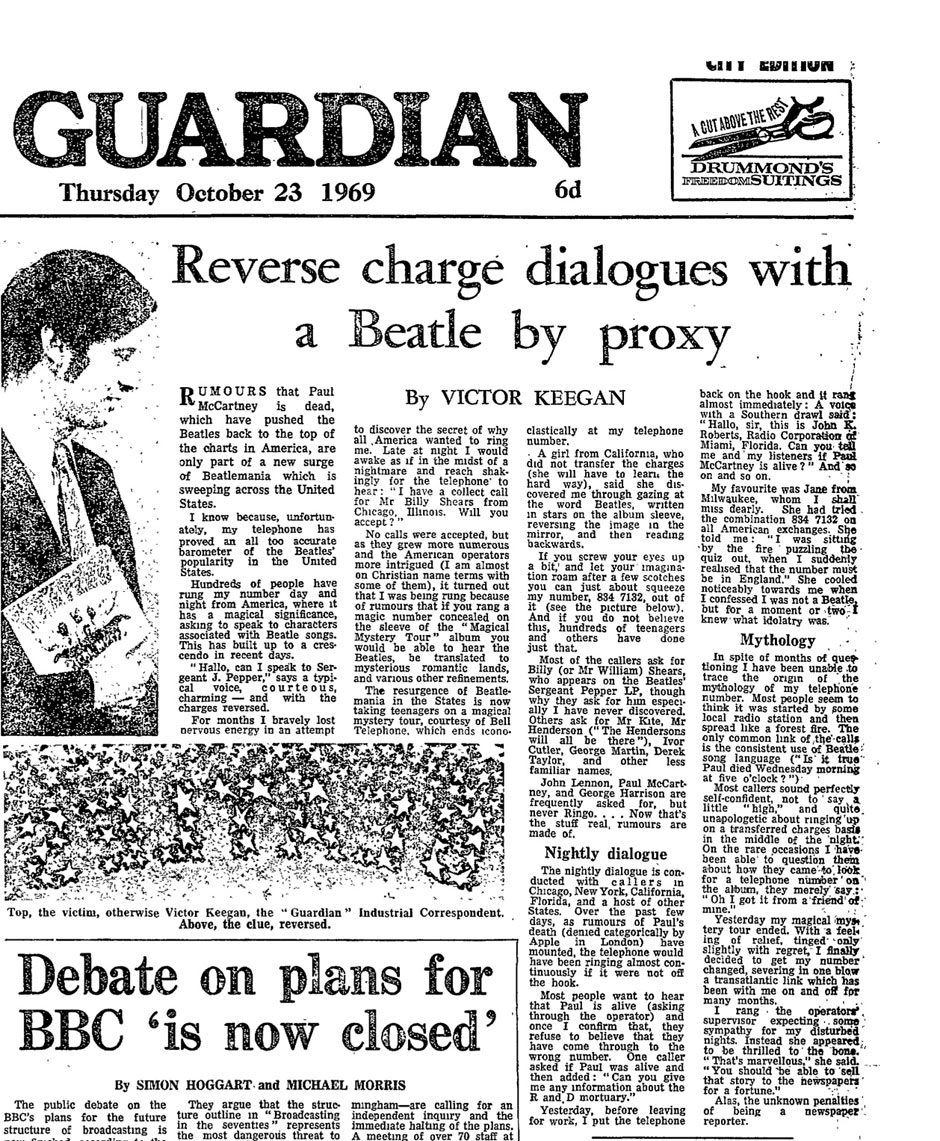
Victor Keegan's Guardian report on Beatle myths in 1969
Victor Keegan's Guardian report on mysterious phone calls from the US ... 

Monday, June 18, 2012

LftW: 18th June

Not many physics links this week, but plenty of other interesting stuff to make up for it.
  • Like most people I know, I have been following the football games at the current European Championship in Poland and Ukraine quite closely. Generally speaking the football has been very exciting, but there has also been some scrutiny of the venues for the games, and quite a bit of discussion about racism and anti-Semitism in both countries. A lot of this possibly stems from the history of the region; in The Observer, Michael Goldfarb wrote about the Ukrainian city of Lviv, formerly Polish Lwów, Russian Львов and German Lemsberg. A few days before that, The New York Review of Books had carried a review of a film about Lviv by Polish director Agnieszka Holland. Well worth reading both for some historical perspective.
  • On the topic of European political geography, there was a great YouTube video which went viral a couple of weeks ago, showing a time lapse of the changing political map of Europe from AD 1000 to 2006 in about 11 minutes, with notes about the main events and battles included. If, like me, you didn't know a great deal about the history of Europe but were fascinated by little tidbits such as the Spanish and Austrian dynasties being related, it was very educational. Unfortunately it has since been taken down by the copyright holders, so I can't link it here. Instead, you can have a look at the maps on this website, showing the boundaries at intervals of every hundred years, from AD 1  to the present. A poor substitute for the video, but pretty good nevertheless.
  • The British government's self-imposed austerity policy was always an unnecessary, ideologically motivated gamble, which several respectable economists opposed from the start. As it happens, events have proven their fears right, but the Conservatives have been reluctant to change course, because to do so would be openly admit their initial mistake. Nevertheless, George Osborne has been giving a big economic policy speech this week, in which Jonathan Portes catches him implicitly admitting that he was wrong and the Keynesians were right all along. There's more on this from the polite-but-scathing Simon Wren-Lewis, and the simply scathing Paul Krugman.
  • Germany will be playing Greece in the quarter-finals at the Euros in a few days, so perhaps it is worth recalling a previous game between these two nations (hat tip to Elton):
  • And finally, James Felce's blog post The War of The Immune Worlds at partner blog The Trenches of Discovery has made it to the semi-finals of 3 Quarks Daily's science writing competition. Worth a read!

Thursday, May 24, 2012

The World's 50 Highest Peaks

There hasn't been enough about mountains or maps on this blog yet, despite my promises. But today The Guardian has a simply wonderful feature on their data blog: an interactive map that allows you to view the 50 most prominent (note: not "highest", despite my post title!) peaks in the world. It's integrated with Google, so you can view maps, satellite images, and terrain details. In some cases the satellite images are supplemented by aerial photographs. If you download the Google Earth plugin, it will even allow a virtual "flypast" over the mountain in question, letting you view it in 3D. Plus there's lots of data on elevation, prominence, first ascents and so on.

I've included a screenshot from the map. This is a zoom in on the Google Earth view of Kangchenjunga. Click on it for a bigger version.


I dare say I will spend a few hours playing with this!

(The map was originally made by Robert Mundigi, and was taken from here.)

Wednesday, May 9, 2012

A Blog Manifesto

Welcome to Blank On The Map! I have spent a long time reading and commenting on other people's blogs — long enough now, I feel, to have a good idea of what I would like my own blog to look like. In this first post I'd like to set out an overview of what you can expect to find here.

My main intention is to provide a discussion of interesting issues and topics in physics, and in particular in my own area of expertise, cosmology. Of course there already exist several excellent blogs that cover part of the same subject area: you can find some of my favourite ones listed in the right-hand panel. But in my opinion the broad questions that cosmology is concerned with — what is the Universe made of, how did it start, and how will it end? — are sufficiently interesting that the interwebs can handle another blog on the topic!

Different science bloggers approach the question of what level to pitch their offerings at differently. Although I will from time to time discuss relatively technical issues, and occasionally open research questions, in general I will address my posts to the educated layman rather than the expert. In most cases I will link in to other discussions on the 'blogosphere'; some of these may occasionally provide more details for those who are interested.

Of course, many of the best physics blogs do not restrict themselves merely to physics, and this one will not be any different! I enjoy writing in general, and constructing arguments in particular; one of the main motivations behind starting this blog was to provide an outlet for these urges. So on these pages you may also expect to find pieces on mountaineering and mountains, philosophical discussions of the point of universities and science education, arguments on economic and political issues, and general whimsical diversions. On some of these issues I am well aware I have no special expertise, and I will try to avoid the stereotype of the arrogant physicist talking of that which he does not know. But as friends and family will testify, a lack of knowledge of a subject does not usually prevent me from expressing an opinion on it, and it's probably not going to start now.

I reckon on putting something on here every week, perhaps more often while I have a backlog of things I have been meaning to write about.

Finally, before I end a somewhat over-long first post, a word of explanation about the title of the blog. In part it is intended as a description of what research is about: venturing where no-one has been before, pushing the boundaries and adding, by whatever tiny fraction, to the sum total of human knowledge. It is also the title of a famous book by Eric Shipton, one of the great mountaineers and explorers of the 20th century, an inspiring author and a teenage hero of mine — about whom I might write a little more in the future.

In a lighter vein, Blank On The Map also appealed to me as a reference to the Bellman's map in Lewis Carroll's wonderful The Hunting of the Snark -- a map the crew could all understand -- and to my current location here in Germany, which is rumoured not to exist. An obvious choice then!