Showing posts with label maps. Show all posts

Sunday, June 23, 2013

Across the Himalayan Axis

I had promised to try to write a summary of the workshop on cosmological perturbations post Planck that took place in Helsinki in the first week of June, but although the talks were all interesting, I didn't feel very inspired to write much about them. Plus life has been intervening, so I'll have to leave you to read Shaun's accounts at the Trenches of Discovery instead.

I also recently put a new paper on the arXiv; despite promising to write about my own papers when I put them out, I'm going to have to postpone an account of this one until next week. This is because I am spending the next week at a rather unique workshop in the Austrian Alps. (This is one of the perks of being a physicist, I suppose!)

Therefore today's post is going to be about mountaineering instead. It is an account I wrote of a trek I did with my father and sister almost exactly seven years ago: we crossed the main Himalayan mountain range from south to north over a mountain pass known as the Kang La (meaning 'pass of ice' in the local Tibetan dialect, I believe), and then crossed back again from north to south over another pass as part of a big loop. In doing so we also crossed from the northern Indian state of Himachal Pradesh into Zanskar, a province of the state of Jammu and Kashmir, and then back again.

The account below was first written as a report for the A.C. Irvine Travel Fund, who partly funded this trip, and it has been available via a link on their website for several years. At the time, the Kang La was a very infrequently-used pass, in quite a remote area and only suitable for strong hikers with high-altitude mountain experience. But in the seven years since my trip it has seen quite a rise in popularity — I sometimes flatter myself that my account had something to do with raising the profile of the area!

Anyway, the account itself follows after the break. There is also a sketch map of the area I drew myself (it's hard to obtain decent cartographical maps of the area, and illegal to possess them in India due to the proximity to the border), and a few photographs to illustrate the scenery ...

Monday, May 27, 2013

An inconsistent CMB?

When the Planck science team announced their results in March, they also put out a great flood of papers. You can find the list here; there are 29 of them, plus an explanatory statement.

Except if you look carefully, only 28 of the papers have actually been released. Paper XI, 'Consistency of the data', is still listed as "in preparation". Now, what this paper was supposed to cover was the question of how consistent Planck results were with previous CMB experiments, such as WMAP. We already knew that there were some inconsistencies, both in the derived cosmological parameters such as  the dark energy density and the Hubble parameter, and in the overall normalization of the power seen on large scales. We might expect this missing paper to tell us the reason for the inconsistencies, and perhaps to indicate which experiment got it wrong (if any). The problem is that at present there is no indication when we can expect this paper to arrive – when asked, members of the Planck team only say "soon". I presume that the reason for the delay is that they are having some unforeseen difficulty in the analysis.

However, if you were paying attention last week, you might have noticed a new submission to the arXiv that provided an interesting little insight into what might be going on. This paper by Anne Mette Frejsel, Martin Hansen and Hao Liu – the authors are at the Niels Bohr Institute in Copenhagen, and in fact all three recently visited Bielefeld for our Kosmologietag workshop – applied a particular consistency check to Planck and WMAP data ... and found WMAP wanting.

The test they applied is really pleasingly simple. Suppose you want to measure the CMB temperature anisotropies on the sky using your wonderful satellite – either WMAP or Planck. Unfortunately, there's a great big galaxy (our galaxy) in the way, obscuring quite a large fraction of the sky:

The CMB sky as seen by Planck in the 353 GHz channel.  Obviously there's a lot of foreground in the way. (This is not the best frequency for viewing the CMB, by the way. I chose it only because it illustrates the foregrounds quite nicely!)

Now, as I've mentioned before, there are clever ways of removing this foreground and getting to the underlying CMB signal. The CMB signal is what is interesting for cosmologists, because that is what gives us the insight into fundamental physics. Foregrounds are about messy stuff to do with the distribution of dust in our galaxy: the details are complicated, but the underlying physics is not that interesting (ok, maybe it is, but to different people). Anyway, using their clever techniques (and measurements of the CMB+foreground at several different frequencies), the guys at Planck or WMAP can come up with the best map they can that they think represents the CMB with foreground removed.

Planck's SMICA map of the CMB.

The map above shows the Planck team's effort. Well actually they produced four different such "CMB only" maps, constructed by four different methods of removing the foregrounds. These are known as the SMICA, SEVEM, NILC and Commander-Ruler maps, the names indicating the different foreground-removal algorithms used. For some reason, Commander-Ruler appears not to be recommended for general use. WMAP on the other hand produced only one, known as the Internal Linear Combination or ILC map. (Planck's NILC is meant to be a counterpart to WMAP's ILC.)

Now, although the algorithms used to produce these maps are, as I said, very clever, the resultant maps are never going to be completely foreground-free. Let's express this as the equation

map = CMB + noise 

where the "noise" term includes foregrounds as well as instrument noise, systematics and other contaminants. If you have more than one map, they see the same fundamental CMB, but the noise contribution to each is different. So you can subtract one from the other to get a new map consisting of their difference:

difference = map1 – map2 = noise1 – noise2.

Since most of the residual noise should be due to the galactic foreground, most of the features in the difference map should be around the galactic plane. If the foreground removal has been reasonably successful, these features should also be small. And for the Planck maps, that is in fact what Frejsel, Hansen and Liu find:

 NILC–SMICA, NILC–SEVEM and SMICA–SEVEM difference maps. Figure from arXiv:1305.4033.

So the various different methods used by Planck seem to give self-consistent answers.

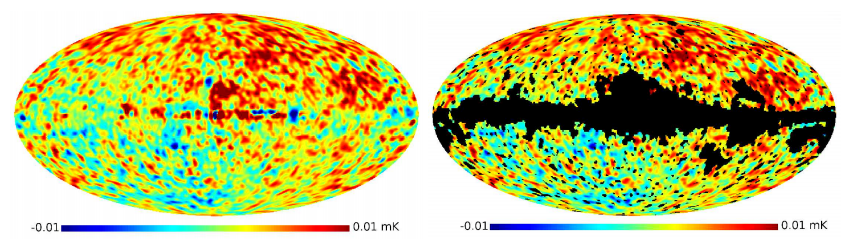
The same is not true, however, for WMAP. Of course WMAP only use the one method of removing foreground, but they did provide different maps based on the data they had collected after 7 years of operation and after 9 years. The ILC9–ILC7 difference map looks quite different:

ILC9–ILC7 difference map on the left, and with a galactic mask overlaid on the right. Figure from arXiv:1305.4033.

Most of the difference appears well away from the galactic plane, as you can see in the right-hand figure, where the galaxy is masked out. So there is some important source of noise that is not foregrounds – so probably some systematics – that has affected the WMAP ILC map. Even more importantly, it is some kind of systematic effect that has changed between the 7-year and the 9-year WMAP data releases, meaning that the ILC9 and ILC7 maps do not appear to be consistent with each other. Frejsel et al. discuss a method of quantifying this, but I won't go into that here because the impression created by the images is both dramatic enough and entirely in line with the quantitative analysis.

As you might have expected, the same method shows that WMAP's ILC9 map is thoroughly inconsistent with the various Planck maps (the picture here is even worse than that between the two ILC maps). But perhaps surprisingly, ILC7 is perfectly consistent with Planck. So it appears that whatever might have affected the WMAP results only affected the final data release.

I guess one should be careful not to make too much of a fuss about this. The results from Planck and WMAP are, generally speaking, in pretty good agreement, except for some problems at the very largest scales. It is also true that the WMAP team themselves do not use the ILC map for most of their analysis (except for the low multipoles, $\ell<32$ – that is, the very largest scales!). But I'm sure this paper will provoke some head-scratching among the WMAP team as they try to figure out what has happened here. Oh, and if you are cosmologist using the ILC9 map for your own analysis, you should probably check whatever conclusions you draw using some other maps before publishing!

All in all, I think I'm rather looking forward to Planck's consistency paper when it does finally come out!

Wednesday, March 20, 2013

The Planck guessing game

At 10 am CET on Thursday morning, the Planck mission will hold a press conference and announce the first cosmology results based on data from their satellite, which has now been in orbit for nearly 1406 days, according to the little clock on their website. (I think the conference information will be available live here, though the website's not as clear as it could be.)

Planck is an incredible instrument, which has been measuring the pattern of cosmic microwave background (CMB) temperature anisotropies with great precision. And the CMB itself is an incredible treasure trove of information about the history of the universe, telling us not only about how it began, but what it consists of, and what might happen to it in the future. When the COBE and WMAP satellites first published detailed data from measurements of the CMB, the result was basically a revolution in cosmology and our understanding of the universe we live in. Planck will provide a great improvement in sensitivity over WMAP, which in turn was a great improvement on everything that came before it.

Another feature of the Planck mission has been the great secrecy with which they have guarded their results. The members of the mission themselves have known most of their results for some time now. Apparently on the morning of March 21st they will release a cache of something like 20 to 30 scientific papers detailing their findings, but so far nobody outside the Planck team itself has much of an idea what will be in them.

So let's have a little guessing game. What do you think they will announce? Dramatic new results, or a mere confirmation of WMAP results and nothing else? I'll list below some of the things they might announce and how likely I think they are (I have no inside information about what they actually have seen). Add your own suggestions via the comments box!
 
Tensors: Planck is much more sensitive to a primordial tensor perturbation spectrum than the best current limits. If they did see a non-zero tensor-to-scalar ratio, indicative of primordial gravitational waves, this would be pretty big news, because it is a clear smoking gun signal for the theory of inflation. Of course there are other bits of evidence that make us think that inflation probably did happen, but this really would nail it.

Unfortunately, I think it is unlikely that they will see any tensor signal – not least because many (and some would argue the most natural) inflation models predict it should be too small for Planck's sensitivity.

Number of relativistic species: CMB measurements can place constraints on the number of relativistic species in the early universe, usually parameterised as the effective number of neutrino species. I wrote about this a bit here. The current best fit value is $N_{\rm eff}=3.28\pm0.40$ according to an analysis of the latest WMAP, ACT and SPT data combined with measurements of baryon acoustic oscillations and the Hubble parameter (though some other people find a slightly larger number).

I would be very surprised indeed if Planck did not confirm the basic compatibility of the data with the Standard Model value $N_{\rm eff}=3.04$. It will help to resolve the slight differences between the ACT and SPT results and the error bars will probably shrink, but I wouldn't bet on any dramatic results.

Non-Gaussianity: One thing that all theorists would love to hear is that Planck has found strong evidence for non-zero non-Gaussianity of the primordial perturbations. At a stroke this would rule out a large class of models of inflation (and there are far too many models of inflation to choose between), meaning we would have to somehow incorporate non-minimal kinetic terms, multiple scalar fields or complicated violations of slow-roll dynamics during inflation. Not that there is a shortage of these sorts of models either …

Current WMAP and large-scale structure data sort of weakly favour a positive value of the non-Gaussianity parameter $f_{\rm NL}^{\rm local}$ that is larger than the sensitivity claimed for Planck before its launch. So if it lives up to that sensitivity billing we might be in luck. On the other hand, my guess (based on not very much) is it's more likely that they will report a detection of the orthogonal form, $f_{\rm NL}^{\rm ortho}$, which is more difficult – but not impossible – to explain from inflationary models. Let's see.

Neutrino mass: The CMB power spectrum is sensitive to the total mass of all neutrino species, $\Sigma m_\nu$, through a number of different effects. Massive neutrinos form (hot) dark matter, contributing to the total mass density of the universe and affecting the distance scale to the last-scattering surface. They also increase the sound horizon distance at decoupling and increase the early ISW effect by altering the epoch of matter-radiation equality.

WMAP claim a current upper bound of $$\Sigma m_\nu<0.44\;{\rm eV}$$ at 95% confidence from the CMB and baryon acoustic oscillations and the Hubble parameter value. But a more recent SPT analysis suggests that WMAP and SPT data alone give weak indications of a non-zero value, so it is possible that Planck could place a lower bound on $\Sigma m_\nu$. This would be cool from an observational point of view, but it's not really "new" physics, since we know that neutrinos have mass.

Running of the spectral index: Purely based on extrapolating from WMAP results, I expect Planck will find some evidence for non-zero running of the spectral index. But given the difficulty in explaining such a value in most inflationary models, I also expect the community will continue to ignore this, especially since the vanilla model with no running will probably still provide an acceptable fit to the data.

Anything else? Speculate away … we'll find out on Thursday!

Saturday, February 16, 2013

Oxford Greenland Expedition

I sometimes wonder about the mix of topics I mention on this blog – is there too much physics, or not enough? Well, today's post is about something completely different: it is a straight-up publicity plug for the Oxford Greenland Expedition. This is a sea-faring and rock-climbing expedition organised by a group of students, and is exactly the kind of exciting exploratory adventure to which the title of this blog refers, so I'd like to support it as best I can. They have a fundraising page here. As I'll try to explain, I think it is a great plan, and they deserve all the support they can get!

The climbing members of the expedition team are all current or former students of Oxford University, and members of the Oxford University Mountaineering Club, whom I have known for a varying number of years (I've climbed on the same rope as many but not all of them). Between them, they have dreamt up an outrageously bold and brilliant plan for a climbing expedition in the Arctic – as the 'Objectives' page of their website puts it, their goals are:
  1. Sail to Greenland!
  2. Climb the Horn of Upernavik!
  3. Sail north! Find an 800 m pillar! Climb it!
  4. Explore for new climbs!
  5. Sail back!
(The rest of the website is quite amusing too, if you poke around it.) The Horn of Upernavik appears to be a very dramatic 1000-metre-high piece of rock rising straight out of the sea near Uummannaq:

The Horn of Upernavik.
It has apparently also been the objective of several previous expeditions to climb the Horn, but none of them have succeeded. So if this team succeeds, they will be making (a small amount of) history ...

Although all are very good climbers and mountaineers, they are definitely firmly within the ranks of the enthusiastic amateurs rather than elite professionals. I think this makes the audacity of the undertaking all the more wonderful, and appealing to romantic ideals.

Incidentally, two of the members of this team (Ian Faulkner and Tom Codrington) were last year part of a different and equally inspiring expedition to Krygyzstan, during which they, along with Ian Cooper, made only the second ever free ascent of the Mirror Route or Rusyaev Route on Peak 4810, after Alex Lowe and Lynn Hill. A report of this climb and some other stuff they did was published here. So they've definitely got a track record with achieving amazing things!

Anyway, best of luck to the team in their efforts this summer!

Monday, June 18, 2012

LftW: 18th June

Not many physics links this week, but plenty of other interesting stuff to make up for it.
  • Like most people I know, I have been following the football games at the current European Championship in Poland and Ukraine quite closely. Generally speaking the football has been very exciting, but there has also been some scrutiny of the venues for the games, and quite a bit of discussion about racism and anti-Semitism in both countries. A lot of this possibly stems from the history of the region; in The Observer, Michael Goldfarb wrote about the Ukrainian city of Lviv, formerly Polish Lwów, Russian Львов and German Lemsberg. A few days before that, The New York Review of Books had carried a review of a film about Lviv by Polish director Agnieszka Holland. Well worth reading both for some historical perspective.
  • On the topic of European political geography, there was a great YouTube video which went viral a couple of weeks ago, showing a time lapse of the changing political map of Europe from AD 1000 to 2006 in about 11 minutes, with notes about the main events and battles included. If, like me, you didn't know a great deal about the history of Europe but were fascinated by little tidbits such as the Spanish and Austrian dynasties being related, it was very educational. Unfortunately it has since been taken down by the copyright holders, so I can't link it here. Instead, you can have a look at the maps on this website, showing the boundaries at intervals of every hundred years, from AD 1  to the present. A poor substitute for the video, but pretty good nevertheless.
  • The British government's self-imposed austerity policy was always an unnecessary, ideologically motivated gamble, which several respectable economists opposed from the start. As it happens, events have proven their fears right, but the Conservatives have been reluctant to change course, because to do so would be openly admit their initial mistake. Nevertheless, George Osborne has been giving a big economic policy speech this week, in which Jonathan Portes catches him implicitly admitting that he was wrong and the Keynesians were right all along. There's more on this from the polite-but-scathing Simon Wren-Lewis, and the simply scathing Paul Krugman.
  • Germany will be playing Greece in the quarter-finals at the Euros in a few days, so perhaps it is worth recalling a previous game between these two nations (hat tip to Elton):
  • And finally, James Felce's blog post The War of The Immune Worlds at partner blog The Trenches of Discovery has made it to the semi-finals of 3 Quarks Daily's science writing competition. Worth a read!

Thursday, May 24, 2012

The World's 50 Highest Peaks

There hasn't been enough about mountains or maps on this blog yet, despite my promises. But today The Guardian has a simply wonderful feature on their data blog: an interactive map that allows you to view the 50 most prominent (note: not "highest", despite my post title!) peaks in the world. It's integrated with Google, so you can view maps, satellite images, and terrain details. In some cases the satellite images are supplemented by aerial photographs. If you download the Google Earth plugin, it will even allow a virtual "flypast" over the mountain in question, letting you view it in 3D. Plus there's lots of data on elevation, prominence, first ascents and so on.

I've included a screenshot from the map. This is a zoom in on the Google Earth view of Kangchenjunga. Click on it for a bigger version.


I dare say I will spend a few hours playing with this!

(The map was originally made by Robert Mundigi, and was taken from here.)

Monday, May 21, 2012

Links for the week: 20th May

I meant to put this out yesterday, but the supernova post took a bit longer to write than I was hoping. Anyway, here's a list of interesting links.

Physics links:
  • Last week I linked to a paper by Moni Bidin, Carraro, Mendez and Smith that claimed to have detected no evidence for dark matter affecting the kinematics of stars in the solar neighbourhood. I mentioned that this was not without controversy, and indeed this morning there was a new preprint by Bovy and Tremaine on the arXiv, who claim the Moni Bidin et al result is due to a key assumption that is not supported by the data. I haven't had time to read the paper yet, so I'll just quote from the abstract:
"We show that this result is incorrect and that it arises from the invalid assumption that the mean azimuthal velocity of the stellar tracers is independent of Galactocentric radius at all heights; the correct assumption -- that is, the one supported by data -- is that the circular speed is independent of radius in the mid-plane."
  • Suppose you have three upturned cups, and you are 90% certain that there is a ball under one of them. You turn two of them over and find no ball — how confident are you that the ball is under the third cup? Philip Gibbs gives a nice little argument illustrating Bayes' theorem, and uses it to argue that we shouldn't give up on SUSY yet.

Other links:

Wednesday, May 9, 2012

A Blog Manifesto

Welcome to Blank On The Map! I have spent a long time reading and commenting on other people's blogs — long enough now, I feel, to have a good idea of what I would like my own blog to look like. In this first post I'd like to set out an overview of what you can expect to find here.

My main intention is to provide a discussion of interesting issues and topics in physics, and in particular in my own area of expertise, cosmology. Of course there already exist several excellent blogs that cover part of the same subject area: you can find some of my favourite ones listed in the right-hand panel. But in my opinion the broad questions that cosmology is concerned with — what is the Universe made of, how did it start, and how will it end? — are sufficiently interesting that the interwebs can handle another blog on the topic!

Different science bloggers approach the question of what level to pitch their offerings at differently. Although I will from time to time discuss relatively technical issues, and occasionally open research questions, in general I will address my posts to the educated layman rather than the expert. In most cases I will link in to other discussions on the 'blogosphere'; some of these may occasionally provide more details for those who are interested.

Of course, many of the best physics blogs do not restrict themselves merely to physics, and this one will not be any different! I enjoy writing in general, and constructing arguments in particular; one of the main motivations behind starting this blog was to provide an outlet for these urges. So on these pages you may also expect to find pieces on mountaineering and mountains, philosophical discussions of the point of universities and science education, arguments on economic and political issues, and general whimsical diversions. On some of these issues I am well aware I have no special expertise, and I will try to avoid the stereotype of the arrogant physicist talking of that which he does not know. But as friends and family will testify, a lack of knowledge of a subject does not usually prevent me from expressing an opinion on it, and it's probably not going to start now.

I reckon on putting something on here every week, perhaps more often while I have a backlog of things I have been meaning to write about.

Finally, before I end a somewhat over-long first post, a word of explanation about the title of the blog. In part it is intended as a description of what research is about: venturing where no-one has been before, pushing the boundaries and adding, by whatever tiny fraction, to the sum total of human knowledge. It is also the title of a famous book by Eric Shipton, one of the great mountaineers and explorers of the 20th century, an inspiring author and a teenage hero of mine — about whom I might write a little more in the future.

In a lighter vein, Blank On The Map also appealed to me as a reference to the Bellman's map in Lewis Carroll's wonderful The Hunting of the Snark -- a map the crew could all understand -- and to my current location here in Germany, which is rumoured not to exist. An obvious choice then!