Showing posts with label dark energy. Show all posts

Monday, February 3, 2014

Does the multiverse explain the cosmological constant?

At the end of the last post on falsifiability, I mentioned the possibility that the multiverse hypothesis might provide an explanation for the famous cosmological constant problem. Today I'm going to try to elaborate a little on that argument and why I find it unconvincing.

Limitations of space and time mean that I cannot possibly start this post as I would like to, with an explanation of what the cosmological problem is, and why it is so hard to resolve it. Readers who would like to learn a bit more about this could try reading this, this, this or this (arranged in roughly descending order of accessibility to the non-expert). For my purposes I will have to simply summarise the problem by saying that our models of the history of the Universe contain a parameter $\rho_\Lambda$ – which is related to the vacuum energy density and sometimes called the dark energy density – whose expected value, according to our current understanding of quantum field theory, should be at least $10^{-64}$ (in units of the Planck scale energy) and quite possibly as large as 1, but whose actual value, deduced from our reconstruction of the history of the Universe, is approximately $1.5\times10^{-123}$. (As ever with this blog, the mathematics may not display correctly in RSS readers, so you might have to click through.)

This enormous discrepancy between theory and observation, of somewhere between 60 and 120 orders of magnitude, has for a long time been one of the outstanding problems – not to say embarrassments – of high energy theory. Many very smart people have tried many ingenious ways of solving it, but it turns out to be a very hard problem indeed. Sections 2 and 3 of this review by Raphael Bousso provide some sense of the various attempts that have been made at explanation and how they have failed (though this review is unfortunately also at a fairly technical level).

This is where the multiverse and the anthropic argument comes in. In this very famous paper back in 1987, Steven Weinberg used the hypothesis of a multiverse consisting of causally separated universes which have different values of $\rho_\Lambda$ to explain why we might be living in a universe with a very small $\rho_\Lambda$, and to predict that if this were true, $\rho_\Lambda$ in our universe would nevertheless be large enough to measure, with a value a few times larger than the energy density of matter, $\rho_m$. This was particularly important because the value of $\rho_\Lambda$ had not at that time been conclusively measured, and many theorists were working under the assumption that the cosmological constant problem would be solved by some theoretical advance which would demonstrate why it had to be exactly zero, rather than some exceedingly small but non-zero number.

Weinberg's prediction is generally regarded as having been successful. In 1998, observations of distant supernovae indicated that $\rho_\Lambda$ was in fact non-zero, and in the subsequent decade-and-a-half increasingly precise cosmological measurements, especially of the CMB, have confirmed its value to be a little more than three times that of $\rho_m$.

This has been viewed as strong evidence in favour of the multiverse hypothesis in general and in particular for string theory, which provides a potential mechanism for the realisation of this multiverse. Indeed in the absence of any other observational evidence for the multiverse (perhaps even in principle), and the ongoing lack of experimental lack of experimental evidence for other predictions of string theory, Weinberg's anthropic prediction of the value of the cosmological constant is often regarded as the most important reason for believing that these theories are part of the correct description of the world. For instance, to provide just three arbitrarily chosen examples, Sean Carroll argues this here, Max Tegmark here, and Raphael Bousso in the review linked to above.

I have a problem with this argument, and it is not a purely philosophical one. (The philosophical objection is loosely the one made here.) Instead I disagree that Weinberg's argument still correctly predicts the value of $\rho_\Lambda$. This is partly because Weinberg's argument, though brilliant, relied upon a few assumptions about the theory in which the multiverse was to be realised, and theory has subsequently developed not to support these assumptions but to negate them. And it is partly because, even given these assumptions, the argument gives the wrong value when applied to cosmological observations from 2014 rather than 1987. Both theory and observation have moved away from the anthropic multiverse.

Sunday, April 7, 2013

Unnecessary spin

A few people have asked me why I have not blogged about the recent announcement about, and publication of, results from the Alpha Magnetic Spectrometer, which were widely touted as a possible breakthrough in the search for dark matter.

The reason I have not is simply that there are many other better informed commenters who have already done so. In case you have not yet read these accounts, you could do worse than going to Résonaances, or Ethan Siegel, or Stuart Clark in the Guardian, who provide commentary at different levels of technical detail. The simple short summary would be: AMS has not provided evidence about the nature of dark matter, nor is it likely to do so in the near future. The dramatic claims to the contrary are spin, pure and simple. Siegel in fact goes so far as to say "calling it misleading is generous, because I personally believe it is deceitful" (emphasis his own).

So I'm not going to make any more comments about that.

However, since this incident brought it up again, I do want to comment on a related piece of annoying spin, which is the habit of physicists in the business of communicating science to the public of making vastly exaggerated claims about the possible practical applications of fundamental physics. The example that caught my attention this week occurred when Maggie Aderin-Pocock – who is apparently a space science research fellow at UCL – appeared on the BBC's Today programme on Thursday to discuss the significance of the AMS findings.

At one point in the discussion the interviewer John Humphrys asked a slightly tricky question: I understand that dark matter and dark energy are endlessly fascinating, he said, and that learning about the composition of the universe is very exciting. But what practical benefits might it bring? The answer Aderin-Pocock gave was that if we understood what dark matter and dark energy were, we might be able to use them to supply ourselves with energy – dark matter as a fuel source.

I'm sorry, but that is just rubbish.

Unfortunately, it's the kind of rubbish that is increasingly commonly voiced by scientists. You may argue that Aderin-Pocock was simply commenting on something she didn't understand – and if you  listen to the whole interview (available here for a few days; skip to the segment between 1h 23m and 1h 26m), including the cringe-worthy suggestion that dark matter and dark energy are the same thing really (because E=mc2, apparently), it's hard to avoid that conclusion. But a few weeks ago I thought I heard Andrew Pontzen and Tom Whyntie suggest something similar about the Higgs boson on BBC Radio 5 (unfortunately this episode is no longer on the iPlayer so I can't check the exact words they used). And here is Jon Butterworth seeming to suggest (in the midst of an otherwise reasonable piece) that the Higgs could be used to power interstellar travel ...

Why do people feel the need to do this? It's patently rubbish, and they know better. Do we as a scientific community feel that continued public support of science is so important that we should mislead or deceive the public in order to guarantee our future access to it? Do we feel that there is no convincing honest case to be made instead? Or are we just too lazy to make the honest case, and so rely on the catchy but inaccurate soundbite instead?

I think the sensible answer to the question John Humphrys posed would go something like this. Discovering the nature dark matter is a fascinating and exciting adventure. Knowing the answer will almost certainly have no practical applications whatsoever. However, on the journey to the answer we will have to develop new technologies and equipment (made of ordinary matter!) which may serendipitously turn out to have spin-off applications that we cannot yet foresee. More importantly, the very fact that the search is fascinating is part of what draws talented and creative young minds to physics – indeed to science – in the first place, from where they go on to enrich our society in a myriad different ways, none of which may later be connected to dark matter at all. I tried to make this case at greater length here in the early days of this blog.

It's a more subtle argument than just throwing empty phrases about "energy source" around, and it might be hard to reduce to a sound-byte. But it is justifiable, and also honest. And since science is after all about careful argumentation, let's have less spin all round please.

Thursday, March 21, 2013

What Planck has seen

Update at 16:30 CET: I've now had a chance to listen to the main science briefing, and also to glance at some of the scientific papers released today, albeit very briefly. So here are a few more thoughts, though in actual fact it will take quite some time for cosmologists to fully assess the Planck results.

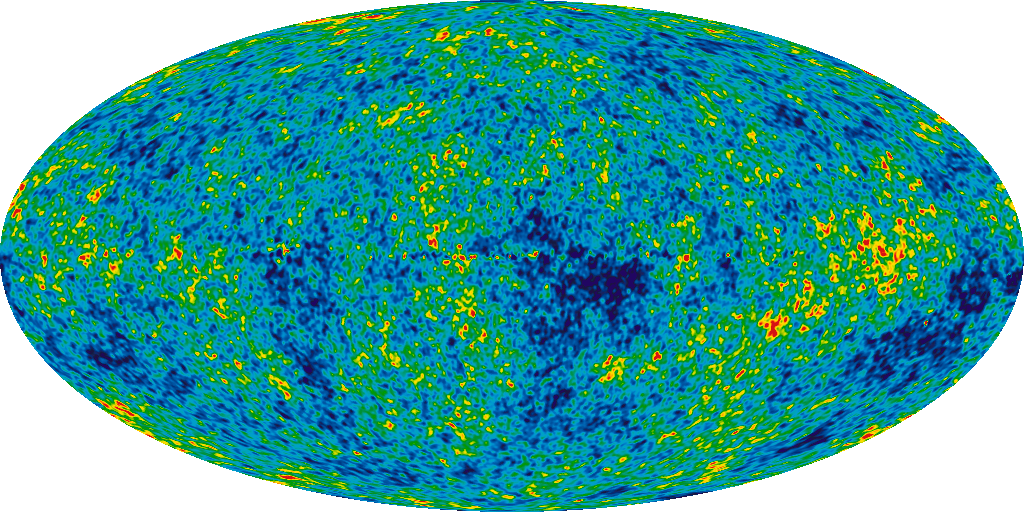
The first thing to say – and it's something easy to forget to say – is just what a wonderful achievement it is to send a satellite carrying two such precise instruments up into space, station it at L2, cool the instruments to a tenth of a degree above absolute zero with a fluctuations of less than one part in a million about that, spin the satellite once per minute, scan the whole sky in 9 different frequency bands, subtract all the messy foreground radiation from our own galaxy and even our solar system, all to obtain this perfect image of the universe as it was nearly 14 billion years ago:

The CMB sky according to Planck.

So congratulations and thanks to the Planck team!

Now I said all that first up because I don't want to now sound churlish when I say that overall the results are a little disappointing for cosmologists. This is because, as I noted earlier in the day, there isn't much by way of exciting new results to challenge our current model of the universe. And of course physicists are more excited by evidence that what they have hitherto believed was wrong than by evidence that it continues to appear to be right.

There are however still some results that will be of interest, and where I think you can expect to see a fair amount of debate and new research in the near future.

Firstly, as I pointed out earlier, Planck sees the same large scale anomalies as WMAP, thus confirming that they are real rather than artifacts of some systematic error or foreground contamination (I believe Planck even account for possible contamination from our own solar system, which WMAP didn't do). These anomalies include not enough power on large angular scales ($\ell\leq30$), an asymmetry between the power in two hemispheres, a colder-than-expected large cold spot, and so on.

The problem with these anomalies is that they lie in the grey zone between being not particularly unusual and being definitely something to worry about. Roughly speaking, they're unlikely at around a 1% level. This means that how seriously you take them depends a lot on your personal prejudices priors. One school of thought – let's call it the "North American school" – tends to downplay the importance of anomalies and question the robustness of the statistical methods by which they were analysed. The other – shall we say "European" – school tends instead to play them up a bit: to highlight the differences with theory and to stress the importance of further investigation. Neither approach is wrong, because as I said this is a grey area. But the Planck team, for what it's worth, seem to be in the "European" camp.

The second surprise is the change in the best-fit values for the parameters of the simplest $\Lambda$CDM model. In particular the Hubble parameter is lower than WMAP's, which was already getting a bit low compared to distance-ladder measurements from supernovae. This will be a cause for concern for the people working on distance-ladder measurements, and potentially something interesting for inventive theorists.

And finally, something close to my own heart. A few days ago I wrote a post about the discrepancy in the integrated Sachs-Wolfe signal seen from very rare structures, and pointed out that this effect had now been confirmed in two independent measurements. Almost immediately I had to change that statement, because one of those independent measurements had been partially retracted.

Well, the Planck team have been on the case (here, paper XIX), and have now filled that gap with a second independent measurement (as well as re-confirming the first one). The effect is definitely there to be seen, and it is still discrepant with $\Lambda$CDM theory (though I'll need to read the paper in more detail before quantifying that statement).

So there's a ray of hope for something exciting.

 
11:30 am CET: Well, ESA's first press conference to announce the cosmological results from Planck has just concluded. The full scientific papers will be released in about an hour, and there will be a proper technical briefing on the results in the afternoon (this first announcement was aimed primarily at the media). However, here is a very quick summary of what I gathered is going to be presented:
  • The standard Lambda Cold Dark Matter Model continues to be a good fit to CMB data
  • However, the best fit parameters have changed: in particular, Planck indicates slightly more dark matter and ordinary (baryonic) matter than WMAP did, and slightly less dark energy. (This is possibly not a very fair comparison – my hunch is that the Planck values are obtained from Planck data alone, whereas the "WMAP values" that were quoted were actually the best fit to WMAP plus additional (non-CMB) datasets.)
  • The value of the Hubble parameter has decreased a bit, to around 67 km/s/Mpc. Given the error bars this is actually getting a bit far away from the value measured from supernovae, whch is around 74 km/s/Mpc. I think the quoted error bars on the measurement from supernovae are underestimated.  
  • The Planck value of the spectral tilt is a bit smaller than, but consistent with, what WMAP found.
  • There is no evidence for extra neutrino-like species.
  • There is no evidence for non-zero neutrino masses.
  • There is no evidence for non-Gaussianity.
  • There is no evidence for deviations from a simple power-law form of the primordial power spectrum.
  • No polarisation data, and therefore no evidence of gravitational waves or their absence, for around another year.
  • There is evidence for anomalies in the large-scale power, consistent with what was seen in WMAP. We'll have to wait and see how statistically significant this is – the general response to the anomalies WMAP saw could be summarised as "interesting, but inconclusive"; I don't think Planck is going to do a lot better than this (and the bigging-up of it in the press conference might have had more to do with the lack of other truly exciting discoveries), but I'd love to be surprised!
That's about all I got out of the media briefing. Obviously we are all waiting for more details this afternoon! 

Tuesday, March 19, 2013

A real puzzle in cosmology: part II

(This post continues the discussion of the very puzzling observation of the integrated Sachs-Wolfe effect, the first part of which is here. Part II is a bit more detailed: many of these questions are real ones that have been put to me in seminars and other discussions.)

Update: I've been informed that one of the papers mentioned in this discussion has just been withdrawn by the authors pending some re-investigation of the results. I'll leave the original text of the post up here for comparison, but add some new material in the relevant sections.

Last time you told me about what you said was an unusual observation of the ISW effect made in 2008.

Yes. Granett, Neyrinck and Szapudi looked at the average CMB temperature anisotropies along directions on the sky where they had previously identified large structures in the galaxy distribution. For 100 structures (50 "supervoids" and 50 "superclusters"), after applying a specific aperture photometry method, they found an average temperature shift of almost 10 micro Kelvin, which was more than 4 standard deviations away from zero.

Then you claimed that this observed value was five times too large. That if our understanding of the universe was correct, the value they should have seen should not have been definitely bigger than zero. Theory and observation grossly disagree.

Right again. Our theoretical calculation showed the signal should have been at most around 2 micro Kelvin, which is pretty much the same size as the contamination from random noise.

But you used a simple theoretical model for your calculations. I don't like your model. I think it is too simple. That's the answer to your problem – your calculation is wrong.

That could be true – thought I don't think so. Why don't we go over your objections one by one?

Tuesday, March 5, 2013

A real puzzle in cosmology: part I

In a previous post, I wrote about recent updates to the evidence from the cosmic microwave background for extra neutrino species. This was something that a lot of people in cosmology were prepared to get excited about, but I argued that reality turned out to be really rather boring. This is because the new data neither showed anything wrong with the current model of what the universe is made of, nor managed to rule out any competing models.

Today I'd like to write about something else, which currently is a really exciting puzzle. Measurements have been made of a particular cosmological effect, known as the integrated Sachs-Wolfe or ISW effect, and the data show a measured value that is five times larger than it should be if our understanding of gravitational physics, our model of the universe, and our analysis of the experimental method are correct. No one yet knows why this should be so. The point of this post is to try to explain what is going on, and to speculate on how we might hope to solve the puzzle. It has been written in a conversational format with the lay reader in mind, but there should be some useful information even for experts.

Before beginning, I should point out that this what a lot of my own research is about at the moment. In fact, this was the topic of a seminar I gave at the University of Helsinki last week (and much of this post is taken from the seminar). My host in Helsinki, Shaun Hotchkiss, with whom I have written two papers on this "ISW mystery", has also put up several posts about it at The Trenches of Discovery blog over the last year (see here for parts I, II, III, IV, V, and VI). I will be more concise and limit myself to just two!

Obviously you could view this as a bit of an effort at self-publicity. But at a time when, both in particle physics and cosmology, many experiments are disappointingly failing to provide much guidance on new directions for theorists to follow, this is one of the few results that could do so. (Unlike a lot of the rubbish you might read in other popular science reports, it also has a pretty good chance of being true.) So I won't apologise for it!

What is the integrated Sachs-Wolfe effect?

The entire universe is filled with very cold photons. These photons weren't always very cold; on the contrary, they are leftovers from the time soon after the Big Bang when the universe was still very young and very small and very hot, so hot that all the protons and electrons (and a few helium nuclei) formed a single hot plasma, the photons and electrons bouncing off each so often that they all had the same temperature. And as the universe was expanding, this plasma was also cooling, until suddenly it was cool enough for the electrons and protons to come together to form hydrogen atoms, without immediately getting swept apart again. And when this happened, the photons stopped bouncing off the electrons, and instead just continued travelling straight through space minding their own business, cooling as the universe continued to expand. (The neutrinos, which only interact weakly with other stuff, had stopped bouncing and started minding their own business some time before this.)

What I've just told you is a cartoon picture of the history of the early universe. These cooling photons streaming through space form the cosmic microwave background radiation, or CMB for short. They fill the universe, and they arrive at Earth from all directions – they even make up about 1% of the 'snow' you see on an (old-school) untuned TV set. 

The most important property of the CMB photons is that, to a very great degree of accuracy, they are all at the same temperature, whichever direction they come from. This is how we know that the universe used to be very hot, and how we learned that it has been expanding since then. It is also why we think it is probably very uniform. The second important property of CMB photons is that they are not all at the same temperature – by looking carefully enough with an extremely sensitive instrument, we can see tiny anisotropies in temperature across the sky. These differences in temperature are the signs of the very small inhomogeneities in the early matter-radiation plasma which are responsible for all the structure we see around us in the night sky today. When the photons decoupled from the primordial plasma, they kept the traces of the tiny inhomogeneities as they streamed across the universe. The matter, on the other hand, was subject to gravity, which took the small initial lumpiness and over billions of years caused it to become bigger and lumpier, forming stars, galaxies, clusters of galaxies and vast clusters of clusters.

The CMB sky as seen by the WMAP satellite. The colours represent deviations of the measured CMB temperature from the mean value – the CMB anisotropies (red is hot and blue is cold). This map uses the Mollweide projection to display a sphere in two dimensions. Image credit: NASA / WMAP Science team. 

Yes I knew that, but what is the integrated Sachs-Wolfe effect?

Thursday, November 22, 2012

The Structure of a Scientific Revolution

A few days ago, Peter Coles posted an interesting comment about skepticism on his blog. In it, he showed the first graphs with data showing evidence for the acceleration of the expansion of the Universe from observations of distant supernovae. His point was that though the plot isn't much to look at, the statistical evidence for cosmic acceleration from supernovae data was quickly established and very soon became very widely believed.

Coles goes on to make some points about global warming skepticism, and most of the long discussion in the comments that follow is concerned with this. Which is unfortunate, as none of that discussion provides an exception to the general rule that arguments about global warming are a complete waste of time, because people have already decided what they want to believe before they start, and are subsequently impervious to any evidence, logic or persuasion. So although you may want to read the discussion there, let's not talk about the climate here.

Instead, I want to stick with the cosmology and pick up on a question that is more interesting. Let's take a quick look at the picture of the supernovae data from the High-Z Supernova Search Team and the Supernova Cosmology Project:
Evidence for dark energy from the Hubble diagram of supernovae. The top panel shows the distance modulus of the supernovae as a function of redshift, with three different theoretical model curves. The bottom panel shows the residual distance modulus relative to that in the model with the dotted curve (a Milne universe).
As Coles points out, most people who are not cosmologists (and some who are) look at these data and find them deeply unconvincing. The error bars are large. The points are widely scattered, and at least both the top two curves seem to give reasonably good fits. On top of that, there appear to be two distinct groups of supernovae: one group rather close to us, and the other much further away at higher redshifts (and therefore observed as they were a long time ago). Any inferences we draw from relative calibrations of these two groups rest on the assumption that deep down they are the same kind of objects, and that the Universe they existed in remained the same kind of Universe.

So why exactly did this cause such a revolution in the field? How did so many physicists become convinced, almost overnight, of the existence of this mysterious dark energy, that constitutes most of the energy of the Universe, but that we didn't understand then and don't understand now?