Saturday, March 15, 2014

B-modes, rumours, and inflation

Update: The announcement will definitely be about a major discovery by BICEP2, meaning it can only really be about a B-mode signal. You can follow the webcast at  http://www.cfa.harvard.edu/news/news_conferences.html, starting at 10:45 am EDT (14:45 GMT) for scientists, or 12:00 pm EDT (16:00 GMT) for the general public and news organisations.

The big news in cosmology circles at the minute is the rumour that the "major discovery" due to be announced at a press conference on Monday the 17th is in fact a claimed detection of the B-mode signal in the CMB by the the BICEP2 experiment.

Now, I'm not particularly well placed to comment on this rumour, since all the information I have comes at second- or third-hand, via people who have heard something from someone, people who think they heard something from someone, or people who are simply unashamedly speculating. (Perhaps this is a function of being on the wrong side of the Atlantic: although the BICEP2 experiment is based at the South Pole, the only non-North-American university participating in the collaboration is Cardiff University in Wales. Even worse, I'm not on Twitter.) In any case, by reading thisthisthis and this, you will be starting with essentially the same information as me.

But having got that health warning out of the way, let's pretend that the rumours are entirely accurate and that on Monday we will have an announcement of a detection of a significant B-mode signal. What would this mean for cosmology?

Firstly, the B-mode signal refers to a particular polarisation of the CMB (for a short and somewhat technical introduction, see here; for a slightly longer one, see here). This polarisation can arise in various ways, one of which is the polarisation induced in the CMB by gravitational lensing, as the CMB photons travel through the inhomogeneous Universe on their way from the last scattering surface to us. There have been a few experiments, such as POLARBEAR, which have already claimed a detection of this lensing contribution to the B-mode signal (though in this particular case after skim-reading the paper I was a little underwhelmed by the claim).

Now, detecting a lensing B-mode would be cool, but significantly less exciting than detecting a primordial B-mode. This is because whereas the lensing signal comes from late-time physics that is quite well understood, a primordial signal would be evidence of primordial tensor fluctuations or primordial gravitational waves. And this is cool because inflation provides a possible way to produce primordial gravitational waves – therefore their detection could be a major piece of evidence in favour of inflation.

The contributions to the B-mode signal coming from gravitational waves and lensing are differentiated on the basis of the multipoles (essentially the length scale) at which they are important. Figure from Hu and Dodelson 2002.

People often say that detection of this tensor signal would be a "smoking gun" for inflation; something that would be very welcome, because although inflation has proved to be an attractive and fertile paradigm for cosmology, there is still a bit of a lack of direct, incontrovertible evidence in favour of it. Coupled with certain unresolved theoretical issues it faces, this lack of a smoking gun meant that arguments for or against inflation were threatening to degenerate into what you might call "multiverse territory", definitely an unhealthy place to be.

It may be worth introducing a note of caution about this "smoking gun" though. Although inflation is a possible source of primordial gravitational waves, it is not the only one. Artefacts of possible phase transitions in the early universe, known as cosmic defects, can also produce a spectrum of gravitational waves – and what's more, this spectrum can be exactly scale-invariant, just as that from inflation. I don't know a huge amount about this field, so I am not sure whether the amplitude of the perturbations which could be produced by these cosmic defects could be sufficiently large, nor – if it is – whether there are any other features which could help distinguish this scenario from inflation if the rumours turn out to be true. Perhaps better informed people could comment below.

Suppose we put that issue to one side though, and assume that not only has a significant tensor signal been detected, we have also been able to prove that it could not be due to anything other than inflation. The rumour is that the detection corresponds to value for the tensor-to-scalar ratio r of about 0.2. What are the implications of this for the different inflation models?

Planck limits on various inflationary models.
Not all models of inflation do result in tensor modes large enough to observed in the CMB, so an observation of a large r would rule out a large class of these models. Generally speaking, the understanding is that models in which the inflaton field $\phi$ takes large values (i.e., values larger than the Planck mass $M_P$) are the ones which could produce observably large r, whereas the so-called "small-field models" where $\phi\ll M_P$ usually predict tiny values of r which could never be observed. (A note for non-experts: irrespective of the field value, the energy scale in both small-field and large-field models is always much less than the Planck scale.) Therefore, at a stroke, all small-field inflation models would be ruled out. Many people regard these as the better-motivated models of inflation, with in some respects fewer theoretical issues than the large-field models, so this would be quite significant.

There are two small caveats to this statement: firstly, it isn't strictly necessary for $\phi$ itself to be larger than $M_P$ to generate a large r, only that the change in $\phi$ be large. So models in which the inflaton field winds around a cylinder, in effect travelling a large distance without actually getting anywhere, can still give large r (hat-tip to Shaun for that phrasing). Also, it is not even strictly true that the change in $\phi$ must be large: if some other rather specific conditions (including the temporary breakdown of the slow-roll approximation) are met, this one can be avoided and even small field models can produce enough gravitational waves. This was something pointed out by a paper I wrote with Shaun Hotchkiss and Anupam Mazumdar in 2011, though other people had similar ideas at about the same time. Such rather forced small-field models would have other specific features though, so could be distinguished by other measurements.

One of the more interesting consequences of a detection of large r (aside from the earth-shattering importance of a confirmation of inflation itself) would be that the Higgs inflation model – which has been steadily gaining in popularity given the results from the LHC and Planck, and has begun to be regarded by many as the most plausible mechanism by which inflation could have occurred – would be disfavoured. In the plot above, the Higgs inflation prediction is shown by the orange points at the bottom centre of the figure. So a BICEP2 detection of $r\sim0.2$ as suggested by the rumours would be pretty serious for this model.

On the other hand, a BICEP2 detection of $r\sim0.2$ would also strongly contradict appear to be at odds with the results from the Planck and WMAP satellites. Which probably goes to show that there is not much point believing every rumour ...

We will find out on Monday!

Monday, February 3, 2014

Does the multiverse explain the cosmological constant?

At the end of the last post on falsifiability, I mentioned the possibility that the multiverse hypothesis might provide an explanation for the famous cosmological constant problem. Today I'm going to try to elaborate a little on that argument and why I find it unconvincing.

Limitations of space and time mean that I cannot possibly start this post as I would like to, with an explanation of what the cosmological problem is, and why it is so hard to resolve it. Readers who would like to learn a bit more about this could try reading this, this, this or this (arranged in roughly descending order of accessibility to the non-expert). For my purposes I will have to simply summarise the problem by saying that our models of the history of the Universe contain a parameter $\rho_\Lambda$ – which is related to the vacuum energy density and sometimes called the dark energy density – whose expected value, according to our current understanding of quantum field theory, should be at least $10^{-64}$ (in units of the Planck scale energy) and quite possibly as large as 1, but whose actual value, deduced from our reconstruction of the history of the Universe, is approximately $1.5\times10^{-123}$. (As ever with this blog, the mathematics may not display correctly in RSS readers, so you might have to click through.)

This enormous discrepancy between theory and observation, of somewhere between 60 and 120 orders of magnitude, has for a long time been one of the outstanding problems – not to say embarrassments – of high energy theory. Many very smart people have tried many ingenious ways of solving it, but it turns out to be a very hard problem indeed. Sections 2 and 3 of this review by Raphael Bousso provide some sense of the various attempts that have been made at explanation and how they have failed (though this review is unfortunately also at a fairly technical level).

This is where the multiverse and the anthropic argument comes in. In this very famous paper back in 1987, Steven Weinberg used the hypothesis of a multiverse consisting of causally separated universes which have different values of $\rho_\Lambda$ to explain why we might be living in a universe with a very small $\rho_\Lambda$, and to predict that if this were true, $\rho_\Lambda$ in our universe would nevertheless be large enough to measure, with a value a few times larger than the energy density of matter, $\rho_m$. This was particularly important because the value of $\rho_\Lambda$ had not at that time been conclusively measured, and many theorists were working under the assumption that the cosmological constant problem would be solved by some theoretical advance which would demonstrate why it had to be exactly zero, rather than some exceedingly small but non-zero number.

Weinberg's prediction is generally regarded as having been successful. In 1998, observations of distant supernovae indicated that $\rho_\Lambda$ was in fact non-zero, and in the subsequent decade-and-a-half increasingly precise cosmological measurements, especially of the CMB, have confirmed its value to be a little more than three times that of $\rho_m$.

This has been viewed as strong evidence in favour of the multiverse hypothesis in general and in particular for string theory, which provides a potential mechanism for the realisation of this multiverse. Indeed in the absence of any other observational evidence for the multiverse (perhaps even in principle), and the ongoing lack of experimental lack of experimental evidence for other predictions of string theory, Weinberg's anthropic prediction of the value of the cosmological constant is often regarded as the most important reason for believing that these theories are part of the correct description of the world. For instance, to provide just three arbitrarily chosen examples, Sean Carroll argues this here, Max Tegmark here, and Raphael Bousso in the review linked to above.

I have a problem with this argument, and it is not a purely philosophical one. (The philosophical objection is loosely the one made here.) Instead I disagree that Weinberg's argument still correctly predicts the value of $\rho_\Lambda$. This is partly because Weinberg's argument, though brilliant, relied upon a few assumptions about the theory in which the multiverse was to be realised, and theory has subsequently developed not to support these assumptions but to negate them. And it is partly because, even given these assumptions, the argument gives the wrong value when applied to cosmological observations from 2014 rather than 1987. Both theory and observation have moved away from the anthropic multiverse.

Wednesday, January 22, 2014

Is falsifiability a scientific idea due for retirement?

Sean Carroll argues that it is.

He characterises the belief that "theories should be falsifiable" as a "fortune-cookie-sized motto"; it's a position adopted only by "armchair theorizers" and "amateur philosophers", and people who have no idea how science really works. He thinks we need to move beyond the idea that scientific theories need to be falsifiable; this appears to be because he wants to argue that string theory and the idea of the multiverse are not falsifiable ideas, but are still scientific.

This position is not just wrong, it's ludicrous. 

What's more, I think deep down Sean – who is normally a clear, precise thinker – realises that it is ludicrous. Midway through his essay, therefore, he flaps around trying to square the circle and get out of the corner he has painted himself into: a scientific theory must, apparently, still be "judged on its ability to account for the data", and it's still true that "nature is the ultimate guide". But somehow it isn't necessary for a theory to be falsifiable to be scientific.

Now, I'm not a philosopher by training. Therefore what follows could certainly be dismissed as "amateur philosophising". I'm almost certain that what I say has been said before, and said better, by other people in other places. Nevertheless, as a practising scientist with an argumentative tendency, I'm going to have to rise to the challenge of defending the idea of falsifiability as the essence of science. Let's start by dismantling the alternatives.

Wednesday, January 15, 2014

A new start to blogging in 2014

Well, Blank On The Map has been sadly silent for rather longer than I intended.

There were several reasons for this. I mentioned one of them in the last post on here a few months ago – the need to put my nose to the postdoc research grindstone in order to try to avoid being scooped. As it turns out, we were scooped after all, but there is still more to be said on the matter and in any case the result we were gunning for turned out to be not quite so exciting as we were hoping. More news on that in some future posts perhaps.

Another reason for radio silence was that I found that quite a lot of my work over the last couple of months has turned out to involve more intensive writing – including a lot of time worrying over the careful choice of words, precise phrasing and tone of my written output – than I'd have liked, and almost more of that than actual research. This was mostly because of a recent paper I wrote which led to a bit of a bad-tempered spat ... anyway, the upshot of this was that I did not feel much in the mood for more writing on here.

It also turns out that any kind of a break from blogging is sort of self-sustaining. When you haven't have much time for writing, the simple fact of its scarcity makes you start to place unreasonably high expectations on your output: is this topic really more interesting than that other topic I didn't have time to write about last week?

Ah well. I'll start the new year with this simple post, which also serves as a way of mentioning that I've moved universities and countries: I now live in Helsinki, and work at the University of Helsinki and the Helsinki Institute of Physics. As a result, I now have a new webpage! (Indeed, for complicated reasons, I actually have a second one as well, but it's got the same content.)

When I arrived here in October, Helsinki looked like this:


Now it looks like this:


The next post of this year will deal with more interesting topics!

Monday, September 2, 2013

A long summer

Indeed it has been a long summer, though the good weather appears to be drawing to a close. Over the last few months, I have attended three cosmology conferences or workshops and also been on a two-week holiday in the Dolomites, where I occupied my time by doing things like this:

La Guglia Edmondo de Amicis, near the Misurina lake.
and enjoying views like this:

Cima Piccola di Lavaredo, from the Dibona route on Cima Grande.
This explains the lack of activity here in recent times.

Returning home a couple of weeks ago, I was full of ideas for several exciting blog posts, including a summary of all the hottest topics in cosmology that were discussed at the conferences I attended, and perhaps an account of my argument stimulating discussion with Uros Seljak. However, it has come to my attention that there are other physicists in other parts of the world who happen to be working on the exact same topic that my collaborators and I have been investigating for the last few months. The rule in the research world is of course "publish or perish" (though some wit has suggested that "publish and perish" is more accurate) – so most of my time now will be spent on avoiding being scooped, and the current hiatus on this blog will continue for a short period. Looking on the bright side, once normal service resumes, I hope to have some interesting science results to describe!

In the meantime, I can only direct you to other blogs for your entertainment and enlightenment. Those of you who like physics discussions and have not already read Sean Carroll's blog (a vanishingly small number perhaps?) might enjoy this post about Boltzmann brains. I personally also enjoyed this argument against philosopher Tom Nagel.

For people interested in climbing news, I can report that my friends on the Oxford Greenland Expedition that I mentioned once here have returned safely after a successful series of very impressive climbs. I found their regular reports of their activities in the expedition diary well-written and rather thrilling – not just the climbing, but also the account of the journey to Greenland by sea in the face of seemingly never-ending gales! Well worth a read, as is this.

Thursday, July 11, 2013

Quasars, homogeneity and Einstein

[A little note: This post, like many others on this blog, contains a few mathematical symbols which are displayed using MathJax. If you are reading this using an RSS reader such as Feedly and you see a lot of $ signs floating around, you may need to click through to the blog to see the proper symbols.]

People following the reporting of physics in the popular press might remember having come across a paper earlier this year that claimed to have detected the "largest structure in the Universe" in the distribution of quasars, that "challenged the Cosmological Principle". This was work done by Roger Clowes of the University of Central Lancashire and collaborators, and their paper was published in the Monthly Notices of the Royal Astronomical Society back in March (though it was available online from late last year). 

The reason I suspect people might have come across it is that it was accompanied by a pretty extraordinary amount of publicity, starting from this press release on the Royal Astronomical Society website. This was then taken up by Reuters, and featured on various popular science websites and news outlets, including New ScientistThe Atlantic, National Geographic, Space.com, The Daily Galaxy, Phys.orgGizmodo, and many more. The structure they claimed to have found even has its own Wikipedia entry.

Obligatory artist's impression of a quasar.

One thing that you notice in a lot of these reports is the statement that the discovery of this structure violates Einstein's theory of gravity, which is nonsense. This is sloppy reporting, sure, but the RAS press release is also partly to blame here, since it includes a somewhat gratuitous mention of Einstein, and this is exactly the kind of thing that non-expert journalists are likely to pick up on. Mentioning Einstein probably helps generate more traffic after all, which is why I've put him in the title as well.

But aside from the name-dropping, what about the main point about the violation of the cosmological principle? As a quick reminder, the cosmological principle is sometimes taken to be the assumption that, on large scales, the Universe is well-described as homogeneous and isotropic. 

The question of what constitutes "large scales" is sometimes not very well-defined: we know that on the scale of the Solar System the matter distribution is very definitely not homogeneous, and we believe that on the scale of size of the observable Universe it is. Generally speaking, people assume that on scales larger than about $100$ Megaparsecs, homogeneity is a fair assumption. A paper by Yadav, Bagla and Khandai from 2010 showed that if the standard $\Lambda$CDM cosmological model is correct, the scale of homogeneity must be less than at most $370$ Mpc. 

On the other hand, this quasar structure that Clowes et al. found is absolutely enormous: over 4 billion light years, or more than 1000 Mpc, long. Does the existence of such a large structure mean that the Universe is not homogeneous, the cosmological principle is not true, and the foundation on which all of modern cosmology is based is shaky?

Well actually, no. 

Unfortunately Clowes' paper is wrong, on several counts. In fact, I have recently published a paper myself (journal version here, free arXiv version here) which points out that it is wrong. And, on the principle that if I don't talk about my own work, no one else will, I'm going to try explaining some of the ideas involved here.

The first reason it is wrong is something that a lot of people who should know better don't seem to realise: there is no reason that structures should not exist which are larger than the homogeneity scale of $\Lambda$CDM. You may think that this doesn't make sense, because homogeneity precludes the existence of structures, so no structure can be larger than the homogeneity scale. Nevertheless, it does and they can.

Let me explain a little more. The point here is that the Universe is not homogeneous, at any scale. What is homogeneous and isotropic is simply the background model we use the describe its behaviour. In the real Universe, there are always fluctuations away from homogeneity at all scales – in fact the theory of inflation basically guarantees this, since the power spectrum of potential fluctuations is close to scale-invariant. The assumption that all cosmological theory really rests on is that these fluctuations can be treated as perturbations about a homogeneous background – so that a perturbation theory approach to cosmology is valid.

Given this knowledge that the Universe is never exactly homogeneous, the question of what the "homogeneity scale" actually means, and how to define it, takes on a different light. (Before you ask, yes it is still a useful concept!) One possible way to define it is as that scale above which density fluctuations $\delta$ generally become small compared to the homogeneous background density. In technical terms, this means the scale at which the two-point correlation function for the fluctuations, $\xi(r)$, (of which the power spectrum $P(k)$ is the Fourier transform) becomes less than $1$. Based on this definition, the homogeneity scale would be around $10$ Mpc.

It turns out that this definition, and the direct measurement of $\xi(r)$ itself, is not very good for determining whether or not the Universe is a fractal, which is a question that several researchers decided was an important one to answer a few years ago. This question can instead be answered by a different analysis, which I explained once before here: essentially, given a catalogue with the positions of many galaxies (or quasars, or whatever), draw a sphere of radius $R$ around each galaxy, and count how many other galaxies lie within this sphere, and how this number changes with $R$. The scale above which the average of this number for all galaxies starts scaling as the cube of the radius, $$N(<R)\propto R^3,$$ (within measurement error) is then the homogeneity scale (if it starts scaling as some other constant power of $R$, the Universe has a fractal nature). This is the definition of the homogeneity scale used by Yadav et al. and it is related to an integral of $\xi(r)$; typically measurements of the homogeneity scale using this definition come up with values of around $100-150$ Mpc.

The figure that proves that the distribution of quasars is in fact homogeneous on the expected scales. For details, see  arXiv:1306.1700

To get back to the original point, neither of these definitions of the homogeneity scale makes any claim about the existence of structures that are larger than that. In fact, in the $\Lambda$CDM model, the correlation function for matter density fluctuations is expected to be small but positive out to scales larger than either of the two homogeneity scales defined above (though not as large as Yadav et al.'s generous upper limit). The correlation function that can actually be measured using any given population of galaxies or quasars will extend out even further. So we already expect correlations to exist beyond the homogeneity scale – this means that, for some definitions of what constitutes a "structure", we expect to see large "structures" on these scales too.

The second reason that the claim by Clowes et al. is wrong is however less subtle. Given the particular definition of a "structure" they use, one would expect to find very large structures even if density correlations were exactly zero on all scales.

Yes, you read that right. It's worth going over how they define a "structure", just to make this absolutely clear. About the position of each quasar in the catalogue they draw a sphere of radius $L$. If any other quasars at all happen to lie within this sphere, they are classified as part of the same "structure", which can now be extended in other directions by repeating the procedure about each of the newly added member quasars. After repeating this procedure over all $18,722$ quasars in the catalogue, the largest such group of quasars identified becomes the "largest structure in the Universe".

It should be pretty obvious now that the radius $L$ chosen for these spheres, while chosen rather arbitrarily, is crucial to the end result. If it is too large, all quasars in the catalogue end up classified as part of the same truly ginormous "structure", but this is not very helpful. This is known as "percolation" and the critical percolation threshold has been thoroughly studied for Poisson point sets – which are by definition random distributions of points with no correlation at all. The value of $L$ that  Clowes et al. chose to use, for no apparent reason other than that it gave them a dramatic result, was $100$ Mpc – far too large to be justified on any theoretical grounds, but slightly lower than the critical percolation threshold would be if the quasar distribution was similar to that of a Poisson set. On the other hand, the "largest structure in the Universe" only consists of $73$ quasars out of $18,722$, so it could be entirely explained as a result of the poor definition ...

Now I'll spare you all the details of how to test whether, using this definition of a "structure", one would expect to find "structures" extending over more than $1000$ Mpc in length or with more than $73$ members or whatever, even in a purely random distribution of points, which are by definition homogeneous. Suffice it to say that it turns out one would. This plot shows the maximum extent of such "structures" found in $10,000$ simulations of completely uncorrelated distributions of points, compared to the maximum extent of the "structure" found in the real quasar catalogue.

The probability distribution of extents of largest "structures" found in 10,000 random point sets for two different choices of $L$. Vertical lines show the actual values found for "structures" in the quasar catalogue. The actual values are not very unusual. Figure from arXiv:1306.1700

To summarise then: finding a "structure" larger than the homogeneity scale does not violate the cosmological principle, because of correlations; on top of that, the "largest structure in the Universe" is actually not really a "structure" in any meaningful sense. In my professional opinion, Clowes' paper and all the hype surrounding it in the press is nothing more than that – hype. Unfortunately, this is another verification of my maxim that if a paper to do with cosmology is accompanied by a big press release, it is odds-on to turn out to be wrong.

Finally, before I leave the topic, I'll make a comment about the presentation of results by Clowes et al. Here, for instance, is an image they presented showing their "structure", which they call the 'Huge-LQG', with a second "structure" called the 'CCLQG' towards the bottom left:

3D representation of the Huge-LQG and CCLQG. From arXiv:1211.6256.

Looks impressive! Until you start digging a bit deeper, anyway. Firstly, they've only shown the quasars that form part of the "structure", not all the others around it. Secondly, they've drawn enormous spheres (of radius $33$ Mpc) at the position of each quasar to make it look more dramatic. In actual fact the quasars are way smaller than that. The combined effect of these two presentational choices is to make the 'Huge-LQG' look far more plausible as a structure than it really is. Here's a representation of the exact same region of space that I made myself, which rectifies both problems:

Quasar positions around the "structures" claimed by Clowes et al.

Do you still see the "structures"?

Sunday, June 23, 2013

Across the Himalayan Axis

I had promised to try to write a summary of the workshop on cosmological perturbations post Planck that took place in Helsinki in the first week of June, but although the talks were all interesting, I didn't feel very inspired to write much about them. Plus life has been intervening, so I'll have to leave you to read Shaun's accounts at the Trenches of Discovery instead.

I also recently put a new paper on the arXiv; despite promising to write about my own papers when I put them out, I'm going to have to postpone an account of this one until next week. This is because I am spending the next week at a rather unique workshop in the Austrian Alps. (This is one of the perks of being a physicist, I suppose!)

Therefore today's post is going to be about mountaineering instead. It is an account I wrote of a trek I did with my father and sister almost exactly seven years ago: we crossed the main Himalayan mountain range from south to north over a mountain pass known as the Kang La (meaning 'pass of ice' in the local Tibetan dialect, I believe), and then crossed back again from north to south over another pass as part of a big loop. In doing so we also crossed from the northern Indian state of Himachal Pradesh into Zanskar, a province of the state of Jammu and Kashmir, and then back again.

The account below was first written as a report for the A.C. Irvine Travel Fund, who partly funded this trip, and it has been available via a link on their website for several years. At the time, the Kang La was a very infrequently-used pass, in quite a remote area and only suitable for strong hikers with high-altitude mountain experience. But in the seven years since my trip it has seen quite a rise in popularity — I sometimes flatter myself that my account had something to do with raising the profile of the area!

Anyway, the account itself follows after the break. There is also a sketch map of the area I drew myself (it's hard to obtain decent cartographical maps of the area, and illegal to possess them in India due to the proximity to the border), and a few photographs to illustrate the scenery ...

Tuesday, June 4, 2013

CPPP 13

This week I am attending this workshop in Helsinki. The focus of the workshop is on re-evaluating theoretical issues in cosmology in light of the new data from the Planck satellite. 

Although the data were released in March, so far as I know they have not yet inspired any major theoretical breakthroughs. This is partly because the results were somewhat disappointingly boring, in that there is no smoking-gun indication in the data of failures of our current cosmological model (for more on this, see here), and therefore no clear hints of which extensions of the model we should be looking to explore further. There are still some niggles in the data, to be sure – such as the much advertised "anomalies". But these have not yet led to any major advances either. As a community it seems we cosmologists are still digesting the Planck results.

This workshop should aid that process of digestion. There are many scientists from all over the world attending, and I'm looking forward to hearing what they think about what the data mean. The way the workshop has been organised deliberately leaves plenty of time for discussion in between the scheduled talks, which I think is always the best way to go. I'm not giving a talk myself, though some work I did recently with Shaun Hotchkiss and Samuel Flender, who are both based in Helsinki, will feature in the poster session. Samuel gets most of the credit for preparing our poster though!

I'm not going to attempt to blog about the workshop in real time. Instead I will try to make a few notes and provide a single post at the end of the week touching on what I thought were the most interesting topics of the week. If you want more detail on each day, you should read Shaun's introduction and day-by-day accounts at The Trenches of Discovery. He did a similar thing before for the official ESA Planck conference, which was very successful. But I'd rather him than me, especially as internet access is rather expensive at my hotel!


Meanwhile, the most remarkable fact to note about Helsinki right now is the weather: a thermometer in my hotel said it was 28ºC this morning, which is wonderful outdoors but when combined with quadruple-glazed windows makes nights rather uncomfortable ...

Monday, May 27, 2013

An inconsistent CMB?

When the Planck science team announced their results in March, they also put out a great flood of papers. You can find the list here; there are 29 of them, plus an explanatory statement.

Except if you look carefully, only 28 of the papers have actually been released. Paper XI, 'Consistency of the data', is still listed as "in preparation". Now, what this paper was supposed to cover was the question of how consistent Planck results were with previous CMB experiments, such as WMAP. We already knew that there were some inconsistencies, both in the derived cosmological parameters such as  the dark energy density and the Hubble parameter, and in the overall normalization of the power seen on large scales. We might expect this missing paper to tell us the reason for the inconsistencies, and perhaps to indicate which experiment got it wrong (if any). The problem is that at present there is no indication when we can expect this paper to arrive – when asked, members of the Planck team only say "soon". I presume that the reason for the delay is that they are having some unforeseen difficulty in the analysis.

However, if you were paying attention last week, you might have noticed a new submission to the arXiv that provided an interesting little insight into what might be going on. This paper by Anne Mette Frejsel, Martin Hansen and Hao Liu – the authors are at the Niels Bohr Institute in Copenhagen, and in fact all three recently visited Bielefeld for our Kosmologietag workshop – applied a particular consistency check to Planck and WMAP data ... and found WMAP wanting.

The test they applied is really pleasingly simple. Suppose you want to measure the CMB temperature anisotropies on the sky using your wonderful satellite – either WMAP or Planck. Unfortunately, there's a great big galaxy (our galaxy) in the way, obscuring quite a large fraction of the sky:

The CMB sky as seen by Planck in the 353 GHz channel.  Obviously there's a lot of foreground in the way. (This is not the best frequency for viewing the CMB, by the way. I chose it only because it illustrates the foregrounds quite nicely!)

Now, as I've mentioned before, there are clever ways of removing this foreground and getting to the underlying CMB signal. The CMB signal is what is interesting for cosmologists, because that is what gives us the insight into fundamental physics. Foregrounds are about messy stuff to do with the distribution of dust in our galaxy: the details are complicated, but the underlying physics is not that interesting (ok, maybe it is, but to different people). Anyway, using their clever techniques (and measurements of the CMB+foreground at several different frequencies), the guys at Planck or WMAP can come up with the best map they can that they think represents the CMB with foreground removed.

Planck's SMICA map of the CMB.

The map above shows the Planck team's effort. Well actually they produced four different such "CMB only" maps, constructed by four different methods of removing the foregrounds. These are known as the SMICA, SEVEM, NILC and Commander-Ruler maps, the names indicating the different foreground-removal algorithms used. For some reason, Commander-Ruler appears not to be recommended for general use. WMAP on the other hand produced only one, known as the Internal Linear Combination or ILC map. (Planck's NILC is meant to be a counterpart to WMAP's ILC.)

Now, although the algorithms used to produce these maps are, as I said, very clever, the resultant maps are never going to be completely foreground-free. Let's express this as the equation

map = CMB + noise 

where the "noise" term includes foregrounds as well as instrument noise, systematics and other contaminants. If you have more than one map, they see the same fundamental CMB, but the noise contribution to each is different. So you can subtract one from the other to get a new map consisting of their difference:

difference = map1 – map2 = noise1 – noise2.

Since most of the residual noise should be due to the galactic foreground, most of the features in the difference map should be around the galactic plane. If the foreground removal has been reasonably successful, these features should also be small. And for the Planck maps, that is in fact what Frejsel, Hansen and Liu find:

 NILC–SMICA, NILC–SEVEM and SMICA–SEVEM difference maps. Figure from arXiv:1305.4033.

So the various different methods used by Planck seem to give self-consistent answers.

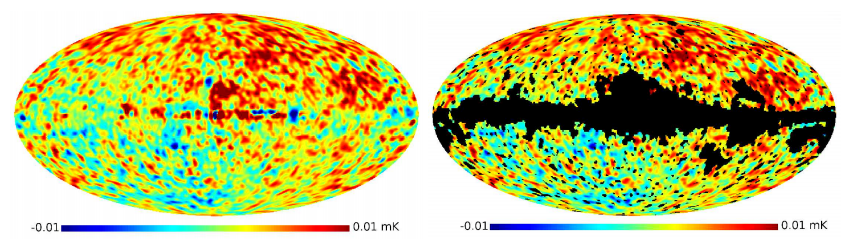
The same is not true, however, for WMAP. Of course WMAP only use the one method of removing foreground, but they did provide different maps based on the data they had collected after 7 years of operation and after 9 years. The ILC9–ILC7 difference map looks quite different:

ILC9–ILC7 difference map on the left, and with a galactic mask overlaid on the right. Figure from arXiv:1305.4033.

Most of the difference appears well away from the galactic plane, as you can see in the right-hand figure, where the galaxy is masked out. So there is some important source of noise that is not foregrounds – so probably some systematics – that has affected the WMAP ILC map. Even more importantly, it is some kind of systematic effect that has changed between the 7-year and the 9-year WMAP data releases, meaning that the ILC9 and ILC7 maps do not appear to be consistent with each other. Frejsel et al. discuss a method of quantifying this, but I won't go into that here because the impression created by the images is both dramatic enough and entirely in line with the quantitative analysis.

As you might have expected, the same method shows that WMAP's ILC9 map is thoroughly inconsistent with the various Planck maps (the picture here is even worse than that between the two ILC maps). But perhaps surprisingly, ILC7 is perfectly consistent with Planck. So it appears that whatever might have affected the WMAP results only affected the final data release.

I guess one should be careful not to make too much of a fuss about this. The results from Planck and WMAP are, generally speaking, in pretty good agreement, except for some problems at the very largest scales. It is also true that the WMAP team themselves do not use the ILC map for most of their analysis (except for the low multipoles, $\ell<32$ – that is, the very largest scales!). But I'm sure this paper will provoke some head-scratching among the WMAP team as they try to figure out what has happened here. Oh, and if you are cosmologist using the ILC9 map for your own analysis, you should probably check whatever conclusions you draw using some other maps before publishing!

All in all, I think I'm rather looking forward to Planck's consistency paper when it does finally come out!

Tuesday, May 21, 2013

One year on

It has been a long month-and-a-bit since I last had the time to write a proper post here. Primarily this is because I am not very good at doing more than one thing at a time – at least while attempting to do those things properly – and I have been working on some real research papers, which I thought I should try to do properly. As a result science communication, and blogging in general, has had to wait. But I will get back in the swing of things very soon: there are some interesting new results, some interesting rehashes of old arguments about inflation, and one of my own papers that I will write about over the next couple of weeks.

One of the many things that I omitted to mention during this little break was the fact that Blank On The Map had its first anniversary a couple of weeks ago. All in all, I would say it has been quite a satisfying year of blogging, and, at least relative to my prior expectations, a reasonably successful one too. Blogger doesn't provide me with many detailed statistics, but it does tell me that despite the low recent rate of new postings, there have been roughly 23,000 clicks over the last twelve months. A sizeable portion of of this traffic came from one link on Peter Woit's blog (boy he must have a huge number of readers!) – though the majority appear to arrive via Google search, either by accident or design.

Anyway, to all those who have arrived here at some point over the last year, welcome! I hope you found what you were looking for, and enjoyed what you read. This explains what this blog is about. In case you haven't worked your way through the archives, here is a short selection of some highlights from the last year:


I should also use this post to try to get some feedback from (all three) regular readers. Do you think I should post more often? Less often? More posts about cosmology and fewer about mountaineering and other stuff in general? Or the other way round? Let me know through the comments box. Constructive criticism of the writing style or any other aspect of this blog will also be well received, though I can't promise to change ...